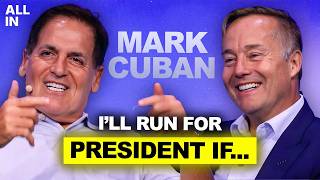
Mark Cuban on the AI Bubble: Who Actually Gets Wiped Out?
Episode Details
In this comprehensive discussion on the All-In Podcast, Mark Cuban engages with Jason Calacanis to explore the nuances of the current AI Bubble. He contrasts this era with previous tech bubbles, noting that massive investments from Venture Capital and Private Equity are currently keeping the bubble private, heavily funding frontier companies like OpenAI, Anthropic, and SpaceX. This unprecedented influx of capital has triggered a massive wave of AI Capex directed toward building physical Data centers. Tech giants like Google, Meta, and Microsoft are leading this charge, attempting to commercialize Enterprise AI. However, Cuban notes that deploying AI directly into traditional enterprises is incredibly challenging, a sentiment echoed by Alex Karp of Palantir, who emphasizes the absolute necessity of utilizing forward-deployed engineers. Despite these enterprise hurdles, Cuban is highly optimistic about AI democratization for smaller businesses, highlighting his investments in startups like Lovable, led by Anton Osika. He also backs Synthesia and Matter.com, pushing beyond text processing to focus on video generation and spatial understanding. The conversation touches on AMI, a project associated with Yann LeCun focused on building World Models. These models are positioned to ultimately surpass traditional Large Language Models (LLMs) and Transformers. In the medical field, Cuban points out that AI in Healthcare is creating a revolution in self-directed patient care, supported by wearable devices like the Apple Watch and biometric trackers like Whoop, alongside highly accurate diagnostic tools like Open Evidence. Shifting to broader business strategy, Cuban advocates for startups to pursue an IPO to acquire public currency for M&A, especially since Lina Khan and the FTC have heavily restricted corporate acquisitions. He also discusses geographic business shifts, praising the pro-business environment of Texas, particularly Austin, Texas, in sharp contrast to the regulatory and taxation burdens found in California and New York. He strongly opposes the Wealth Tax proposed by Elizabeth Warren. Politically, Cuban analyzes how Social Media Algorithms are effectively weaponized by figures across the spectrum, ranging from Donald Trump on the right to Democratic Socialists of America (DSA) candidate Zohran Mamdani on the left. In stark contrast, he views AI models like Claude as mechanisms for Truth (in AI), offering objective answers that users are beginning to trust. Both Cuban and Calacanis stress the critical need for robust legal Immigration to recruit top global talent. Finally, the conversation shifts to sports. Cuban discusses the NBA and his deep history with the Mavs (Dallas Mavericks), reflecting on the success of former players like Jalen Brunson, who now plays for the New York Knicks. He concludes by noting how the transition from traditional cable to the modern Streaming Industry has fundamentally altered franchise valuations.
Key Topics & People
Asset class focused on startup investments that is currently navigating market corrections.
.jpg?width=300)
Host and moderator of the All-In Podcast.

Former US President facing a fourth indictment.
An investment model focused on cash flow positivity, cost restructuring, and sustainable profitability.

.jpg?width=300)


Deep learning algorithms currently driving the AI boom and inciting debates over safety, pacing, and open-source models.
A political organization backing progressive economic policies like subsidized city grocery stores.

A socialist politician pushing for subsidized, city-owned grocery stores in New York City.
Advanced neural networks trained on massive video datasets to simulate physics and real-world environments.
_(cropped).jpg?width=300)
A city praised for utilizing permitting reform and supply-side economics to lower rents.
The application of artificial intelligence into core business workflows.

A key issue influencing voting blocks, particularly entrepreneurial communities fleeing socialism.
The automated content curation systems on platforms that drive political polarization.

A state discussed critically for its slow ballot counting and partisan governance.
.jpg?width=300)
A star player for the New York Knicks.

An NBA basketball team that was heavily analyzed and bet on by Nate Silver.

Large scale facilities housing computer systems, currently experiencing massive demand
_(cropped).jpg?width=300)
Chief AI Scientist at Meta, associated with pioneering world models.
Company launching satellites to create physical world models using spectrography.

Smartwatch by Apple that collects biometric data to fuel health analytics.
An AI company focused on providing verifiable medical and healthcare information.
The delivery of content via digital subscriptions, which now primarily drives modern sports team valuations.
Professional basketball franchise formerly owned entirely by Mark Cuban.
The imperative for large language models to provide factual and unbiased information to retain user trust.

US Senator known for proposing wealth tax models.
A proposed tax on accumulated wealth, criticized by entrepreneurs for lacking behavioral response modeling.

.jpg?width=300)
The utilization of artificial intelligence for medical insights and patient data analysis.

The deep learning architecture that serves as the foundation for modern LLMs.

Founder of Lovable, driving the democratization of software development.
_(cropped).jpg?width=300)
Billionaire entrepreneur, investor, and former owner of the Dallas Mavericks.