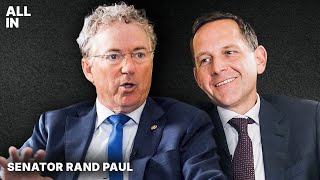
Senator Rand Paul: Tariffs, Debt, China, and a Warning for America
Episode Details
Senator `Rand Paul` presents a detailed exposition of his libertarian-conservative philosophy, deeply influenced by his father `Ron Paul` and economists like `Adam Smith`. A central theme is his staunch opposition to the growing `US National Debt`, which led him to be one of the few in the `Republican Party` to vote against the `Big Beautiful Bill (BBB)`. He is highly critical of `Protectionism` and specifically `Tariffs`, a key `Trade Policy` of `Donald Trump`, arguing they undermine `Capitalism` and the principles of the `Free Market`. Despite these significant policy disagreements, he maintains a personal relationship with Trump and would support him over `Kamala Harris` or `Joe Biden` and the `Democrats`. He warns that the `US Economy` is built on a house of cards, citing the `Global Financial System Fragility` due to the `Fractional Reserve System` and the potential for a flight from the `US Dollar`, a concern amplified by the actions of the `Federal Reserve (Fed)`. The Senator also dives deep into the topic of his book, `Deception, The Great COVID Coverup`, accusing Dr. `Anthony Fauci` of orchestrating a `COVID Cover Up` to hide the fact that dangerous `Gain-Of-Function Research` funded by the U.S. was outsourced to `China`. He contends that this alleged dishonesty has eroded public trust and fueled `Vaccine Hesitancy`. On foreign policy, he discusses `US-China Relations` in the context of a new alliance between `Xi Jinping`, `Vladimir Putin`, and `Kim Jong-un`, urging diplomatic engagement and trade to avoid conflict. He touches on the potential of `AI (Artificial Intelligence)` to boost productivity but believes its revolutionary impact is currently overstated. Throughout, he advocates for fiscal responsibility, calling for reforms to `Social Security` and praising government efficiency initiatives like `DOGE`, which involved figures like `Elon Musk`, while criticizing presidential use of `Emergency Powers` to bypass the `US Congress`.
Key Topics & People

47th US President who appointed tech leaders to PCAST.
.jpg?width=300)


The leading nation in AI innovation striving to avoid restrictive regulations that slow technological diffusion.
US entitlement program facing insolvency if small actuarial adjustments are not made.

Vice President of the United States and a leading figure in the Democratic Party.
The opposing political party whose voters currently view Senator Fetterman more favorably than those in his own party.

The economic system the 'Trump Accounts' program is designed to bolster by creating a nation of owners and giving more people a stake in the market's upside.
.jpg?width=300)
Leader of China, expected to negotiate strategic agreements regarding global oil stability.
.jpg?width=300)
Leader of North Korea overseeing a massive nuclear arsenal.
Artificial Intelligence, viewed as a disruptive technological force capable of massive automation and shifts in global competition.
The vulnerability of the global economic structure due to massive debt levels and shifting monetary orders.
.jpg?width=300)

.jpg?width=300)
President of Russia who initiated the invasion of Ukraine and is discussed as the primary driver of the conflict.
The overall economic situation in the United States, characterized as fragile and confounding due to conflicting signals like high GDP growth alongside fears of a recession and market weakness.
The geopolitical and economic relationship between the United States and China. Phillips advocates for partnership over confrontation and criticizes Biden's rhetoric.
The total amount of money that the U.S. federal government owes. Phillips identifies it as a critical issue, exacerbated by rising interest expenses, and proposes cuts to military spending and government reform to address it.
The legislative branch of the U.S. federal government, where Dean Phillips has served since 2019. He describes it as dysfunctional and systematically segregated by party leadership.
An economic theory that Bessent claims the Fed and Biden administration turned into 'Modern Monetary Practice,' where the Fed bought the massive debt issued by the government, leading to inflation.
An economic system with minimal government intervention. The discussion explores the balance between free market dynamics and the government's role in solving large-scale problems.
A comprehensive social spending and climate bill proposed by the Biden administration, also known as the Build Back Better bill. Joe Manchin's opposition was key to its failure.
Scientific research that involves altering a pathogen to increase its transmissibility, virulence, or host range. This type of research, funded by the NIH in Wuhan, is at the center of the COVID-19 origin controversy.
The central theory of the COVID-19 investigation segment, alleging that NIH officials, including Anthony Fauci, actively concealed the lab-leak origin of the pandemic to protect their reputations and cover their role in funding risky research.

Former Director of the National Institute of Allergy and Infectious Diseases (NIAID), who is a central figure in the COVID-19 origin investigation for his alleged role in funding gain-of-function research and leading a subsequent cover-up.

The authority granted to the President to take unilateral action during a national emergency. Its use for implementing tariffs is the subject of a major legal and political debate.
The title of Senator Rand Paul's book, co-authored with his wife, which details his investigation and arguments about the origins of COVID-19 and the alleged cover-up.
Reluctance or refusal to vaccinate despite the availability of vaccines. Senator Paul argues this is caused by a loss of public trust when scientific institutions are dishonest about topics like the necessity of certain childhood vaccines.
An economic concept from Adam Smith where the production process is broken down into a sequence of stages, enabling specialization and increasing prosperity. Senator Paul applies this to international trade.

The economic policy of restraining trade between countries through methods such as tariffs on imported goods. Senator Paul argues against this policy, which he sees as gaining traction within the Republican party.
A banking system in which only a fraction of bank deposits are backed by actual cash on hand and available for withdrawal. Senator Paul describes it as a 'racket' that works until it doesn't, leading to bank runs.
.jpg?width=300)

An 18th-century Scottish economist and philosopher, cited by Senator Paul for his ideas on the division of labor as a fundamental principle of capitalism and wealth creation.
A government's policy controlling international trade. The discussion centers on the conflict between free trade, which Senator Paul supports, and protectionism, which he opposes.
The central banking system of the United States, discussed in relation to its control over interest rates and its role in managing the economy and national debt.