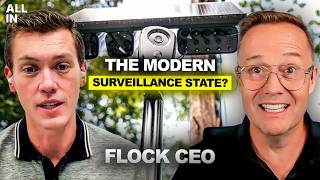
Mass Surveillance, Police Misuse, and Who Controls Your Flock Cameras with Flock CEO, Garret Langley
Episode Details
In this episode, host Jason Calacanis, sponsored by AppLovin, interviews Garrett Langley, the CEO of Flock Safety, to discuss the ongoing debate over Privacy vs. Safety. Flock Safety provides Security Cameras, including Automated License Plate Reader systems and Drones, which are aimed at driving Crime Reduction and improving Public Safety. These technologies integrate with 911 Systems and are heavily utilized by Law Enforcement across various regions, such as San Francisco, Austin, Texas, Atlanta, New York City, Texas, and Georgia. The deployment of these systems depends on the Democratic Process, requiring approval from the Local Government and the City Council. While Flock Safety deliberately avoids using Facial Recognition and limits Artificial Intelligence (AI) to avoid Predictive Policing, it has still experienced a severe PR Crisis resulting in Customer Churn. The backlash has included acts of Vandalism coordinated by activists on social platforms like Instagram, Reddit, and Twitter (X), alongside intense public criticism from media figures like Tucker Carlson. Jason Calacanis advises Garrett Langley to learn from tech executives like Mark Zuckerberg of Facebook, emphasizing the need to get ahead of the narrative. To mitigate the risk of Police Misuse and build Accountability, Flock Safety has mandated a system-wide Audit Log, advocated for a public Transparency Portal, and explored the potential integration of a Third-party Auditor. The conversation also highlights how Default Settings for Data Retention play a critical role. Currently, states like California, New Jersey, Washington, and New Hampshire have implemented varying legal limits on data storage. Civil liberties organizations such as the ACLU strongly advocate for much shorter retention periods and are pushing for a broader Opt-in/Opt-out model. The podcast briefly contrasts Flock's approach with competitors like Ring, founded by Jamie Simonoff. Ultimately, the debate underscores issues of socioeconomic Privilege, noting that while wealthy citizens can afford the private security of a Gated Community, the broader public relies on municipal technological solutions to feel secure.
This episode discusses the tension between public safety and individual privacy, focusing on Flock Safety's license plate readers and drone technology. The conversation highlights how local governments decide on deployment, the importance of data retention policies, and the challenges of public perception and potential misuse of surveillance technology. It also touches on the evolving role of AI in public safety and the need for transparency and accountability.
Portfolio lens: A basket of companies and themes at the intersection of technology, public safety, and privacy, focusing on the evolving regulatory and public perception landscape.
Generated with gemini-2.5-flash-lite on 8/19/2026, 6:36:50 AM. For research only. Not financial advice.Flock Safety's Public Safety Technology Adoption
Flock Safety's continued adoption and expansion of its public safety technology, particularly license plate readers and drones, will be driven by demonstrable crime reduction and effective community engagement, despite ongoing privacy concerns.
The episode details Flock Safety's significant impact on crime solving (over a million crimes solved) and its presence in over 6,000 cities. It also highlights the challenges of public perception and the need for better communication regarding their technology's capabilities and limitations, suggesting that successful navigation of these issues is key to future growth.
- Flock Safety has had a tremendous impact on the country, with north of a million crimes solved using Flock.
- Over 10,000 people found who were missing.
- Flock is in roughly 6,000 cities across the country.
- The company has experienced a severe PR crisis and customer churn due to privacy concerns.
- Garrett Langley emphasizes the need for better communication about what Flock does and does not do.
- Some cities have chosen to turn cameras off, but nearly 20 have turned them back on after realizing they are less safe.
- Increased public demand for safety solutions in communities experiencing rising crime rates.
- Development and implementation of stronger transparency portals and third-party auditing for Flock's systems.
- Successful de-escalation of public concerns through improved communication and education about data usage and privacy safeguards.
- Expansion of drone and live video camera offerings as complementary safety tools.
- Continued or intensified public backlash and activism against surveillance technology, leading to further customer churn or regulatory restrictions.
- Perceived or actual misuse of data by law enforcement, leading to reputational damage and loss of public trust.
- Inability to effectively communicate the nuances of Flock's technology, leading to public confusion and opposition based on misinformation (e.g., conflating Flock with facial recognition).
- Increased regulatory scrutiny and varying state-level data retention laws that could limit the efficacy or adoption of the technology.
- Track Flock Safety's customer acquisition and churn rates in key markets.
- Monitor public sentiment and media coverage regarding ALPR and drone surveillance.
- Analyze regulatory developments concerning data retention periods for surveillance technology at state and federal levels.
- Assess the impact of Flock's transparency initiatives and third-party auditing on public trust.
AI in Public Safety and Law Enforcement
The cautious and human-in-the-loop integration of AI into public safety systems, like those used by law enforcement, presents a significant opportunity for enhanced efficiency and effectiveness, provided privacy and ethical concerns are proactively addressed.
The episode discusses the potential and pitfalls of AI in public safety, particularly concerning 911 systems and pattern analysis. Flock's CEO expresses a desire to move slowly and deliberately with AI, emphasizing the need for human oversight to avoid the risks seen in more aggressive AI deployments, such as those in China.
- The risk of AI in 911 systems is high, with potential for significant errors if not properly controlled.
- AI could be used to analyze patterns, such as a car casing a location, but Flock avoids defining suspicion.
- Flock wants to avoid being a company that defines suspicion, as that is dangerous.
- There's a desire for AI to make officers more effective and objective, but the company is proceeding intentionally slow.
- The episode contrasts Flock's cautious approach with potential AI misuse in authoritarian regimes like China.
- Development of AI tools that demonstrably improve case closure rates and officer objectivity without compromising privacy.
- Successful implementation of AI in non-critical public safety functions (e.g., data analysis, pattern recognition) with clear human oversight.
- Regulatory frameworks that provide clear guidelines and safeguards for AI use in law enforcement.
- Increased adoption of AI by police departments seeking to improve efficiency and resource allocation.
- Public distrust and backlash against AI in law enforcement, fueled by fears of a surveillance state or biased algorithms.
- Technical failures or 'hallucinations' in AI systems leading to incorrect decisions or miscarriages of justice.
- The 'slippery slope' argument, where initial AI applications for efficiency lead to more invasive surveillance and predictive policing.
- Lack of standardization and regulation for AI in public safety, leading to inconsistent and potentially harmful deployments.
- The potential for AI to be used for mass surveillance, similar to concerns raised about China's AI capabilities.
- Track specific AI pilot programs and their outcomes in law enforcement agencies.
- Monitor research and development in AI for pattern recognition and anomaly detection in public safety.
- Analyze proposed regulations and ethical guidelines for AI use by government and law enforcement.
- Investigate the unit economics and ROI of AI-powered public safety solutions.
Watchlist
- Flock Safety customer churn rates
- Number of cities adopting Flock Safety technology
- Regulatory decisions on data retention for ALPR systems
- Public sentiment surveys on surveillance technology
- AI adoption rates in US police departments
- Public discourse on privacy vs. safety trade-offs
Open Questions
- What is the long-term impact of public backlash on Flock Safety's business model and growth trajectory?
- How will varying state and local regulations on data retention affect the efficacy and deployment of ALPR systems?
- What specific AI applications in public safety are most likely to gain traction while mitigating privacy concerns?
- Can Flock Safety effectively differentiate itself from competitors perceived as having fewer privacy safeguards?
- What role will third-party auditors play in building trust for surveillance technology providers?
- How will the 'democratization' of AI tools impact the balance of power between citizens and law enforcement?
- What is the measurable impact of Flock's drone technology on de-escalation and crime prevention?
Key Topics & People
A privacy feature giving individuals the autonomy to remove their vehicles or data from community surveillance networks.
A secured residential area exemplifying private security privilege over public municipal safety tools.
The out-of-the-box configurations set by software companies, which highly dictate end-user data retention habits.
The police departments and governmental bodies empowered to use surveillance tools for investigations.

The system allowing local citizens and their elected officials to debate and decide on integrating safety tech.
The fundamental mission of deploying mass surveillance and rapid-response technology in communities.
The measurable decline in criminal activity, a key value proposition that Flock has contributed to heavily.
An independent review entity proposed to ensure that police departments are strictly adhering to data usage rules.
The structural expectation for transparency and responsible usage of power by law enforcement agencies.
The loss of business clients, which Flock experienced at a marginal rate due to public pushback.
General surveillance hardware used by communities and private citizens for property protection.
The emergency dispatch networks that, when triggered, can deploy Flock drones for rapid situational assessment.
The social network previously known as Twitter, serving as a hub for public backlash and PR challenges.
.svg?width=300)
_(cropped).jpg?width=300)
A prominent media personality who publicly criticized and attacked Flock Safety over privacy concerns.

_(cropped).jpg?width=300)
The CEO of Facebook/Meta, referenced as an executive who historically had to play defense on PR and tech impact.
The unauthorized or malicious abuse of law enforcement databases and surveillance systems by corrupt officers.
The primary ongoing societal debate over balancing individual data protections with community security measures.
A public-facing website providing citizens with visibility into their police department's use of surveillance tech.
The elected bodies within local governments that vote on and approve technology deployments like Flock.
Municipal and county governing bodies responsible for purchasing and overseeing public safety technology.
The controversial use of statistical algorithms and AI to predict crimes before they happen.
The policy and timeframe dictating how long recorded surveillance data is stored before being permanently deleted.
A biometric surveillance technology that Flock explicitly refuses to develop or implement to protect civil liberties.
Advanced computational systems that Flock is intentionally implementing slowly to avoid predictive and subjective biases.
Specialized cameras designed to capture and read vehicle license plates to assist in law enforcement investigations.


A US state with extremely strict data retention laws limiting license plate reading data to just three minutes.
A US state that has adopted statewide regulations and limits regarding data retention.

A state noted for legally mandating a relatively long 5-year data retention requirement for public safety surveillance.

A state with legislation dictating maximum data retention limits for surveillance technologies.

A major metropolitan area referenced for its massive police force and history of policing tactics.

_(cropped).jpg?width=300)
A city that had a high-profile debate over whether to cancel or renew its contracts with Flock.

A major California city that experienced significant crime reduction correlated with increased safety measures.
An entrepreneur and the founder of Ring.
.jpg?width=300)
The host of the All-In Podcast and This Week in Startups, interviewing the CEO of Flock.
The founder and CEO of Flock Safety.
A technology company providing safety cameras, automated license plate readers, and drones to local communities and law enforcement.