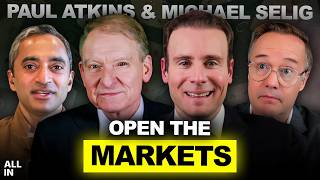
They're Opening the Stock Market to Everyone. Here's What That Actually Means
Episode Details
The episode features hosts Jason Calacanis and Chamath Palihapitiya interviewing SEC Chair Paul Atkins and CFTC Chair Michael Selig. They begin by discussing the evolution of the IPO Market, noting that giants like Apple and Microsoft went public early, creating immense wealth for Retail Investors. Today, as highlighted by an Andreessen Horowitz chart, most returns are captured by Private Equity and Venture Capital. Paul Atkins aims to reform Accredited Investor Rules in collaboration with the Department of Labor to democratize access to these private markets. Michael Selig outlines his focus on Crypto regulation, contrasting his approach with the regulation-by-enforcement era of Gary Gensler. He discusses the necessity of establishing clear rules with the help of David Sacks and the CLARITY Act. The conversation explores the convergence of Artificial Intelligence, Crypto, and finance, touching upon how Autonomous Agents could replace traditional hedge funds like Citadel and Millennium. They examine how Blockchain Technology and Distributed Ledger Technology enable Tokenization and Smart Contracts, paving the way for instantaneous T-Zero Settlement. The discussion turns to systemic risks, particularly Leverage in crypto and the booming sector of Prediction Markets. Chamath Palihapitiya compares the information asymmetry in these markets to issues addressed by Regulation FD, referencing a tweet by Brian Armstrong on Insider Trading. Selig brings up Kalshi, a prediction market that penalized an employee of Mr. Beast for trading on non-public data. Corporate governance is another major topic. Donald Trump recently proposed reducing the frequency of earnings reports, a sentiment echoed by Barry Diller who is tired of Wall Street's short-term gamesmanship. In terms of market structure, the chairs discuss harmonizing SEC and CFTC jurisdictions to allow for innovations like Single Stock Futures and Portfolio Margining. They touch on High Frequency Trading (HFT) dominating futures, the burden of swap data reporting under Dodd-Frank, and the success of the SEC's Alternative Trading Systems (ATS) framework. Finally, they address market protections and fraud. They look back at the Initial Coin Offering (ICO) boom, the rise of speculative Meme coins, and the catastrophic collapse of FTX, noting that its CFTC-regulated entity LedgerX survived. Concerns are raised about retail users losing funds to scams on platforms like Coinbase and falling into algorithm-driven rabbit holes on Twitter (X). Ultimately, they warn of the Gen Z Gambling Crisis, praising platforms like Robinhood for implementing educational friction to protect young investors.
Key Topics & People
The market for Initial Public Offerings which is showing signs of reopening.
Asset class focused on startup investments that is currently navigating market corrections.
.jpg?width=300)
Host on the All-In Podcast who was absent during this episode.
Host on the All-In Podcast, software investor, and venture capitalist.
.jpg?width=300)
Host and moderator of the All-In Podcast.

Former US President facing a fourth indictment.
An investment model focused on cash flow positivity, cost restructuring, and sustainable profitability.


.jpg?width=300)
The social media platform criticized for destroying the chronological feed in favor of algorithms.
The system of using crypto tokens to economically incentivize the building of physical decentralized networks.

Legendary media executive aggressively bidding for and buying shares of MGM Resorts.

A prominent venture capital firm mentioned in contrast to smaller funds.

Co-founder of Coinbase and co-founder of New Limit.
Individual investors buying and selling securities for their personal accounts.
Fair Disclosure rule that governs corporate communications, which members of Congress are exempt from.
.jpg?width=300)
Large hedge fund cited alongside Citadel as a contrast to long-term holding structures.
AI systems capable of executing multi-step tasks independently in software or the physical world without human intervention.
The current Chairman of the CFTC focusing on crypto regulation and market innovation.

US federal department collaborating with the SEC to safely expose pension funds to private markets.
A foundational database technology offering immediate settlement benefits in finance.
Instantaneous clearing and settlement of financial transactions via blockchain.
Self-executing programmable contracts hosted on blockchain networks.
Futures contracts based on individual stocks, hampered by SEC/CFTC jurisdictional overlap.
A methodology calculating margin requirements based on the risk of an entire portfolio.
Non-exchange trading venues regulated as broker-dealers by the SEC.
Financial reform legislation enacted after the 2008 financial crisis affecting derivative markets.
A rising issue of wagering addiction and unregulated speculation among young adult men.
Cryptocurrencies based on internet memes often trading like high-risk speculative stocks.
A method of fundraising using cryptocurrency tokens that bypassed traditional securities laws.
Algorithmic trading characterized by high speeds and high turnover rates.
Regulations defining who is permitted to invest in private, unregistered securities.
The illegal practice of trading on the stock exchange to one's own advantage through having access to confidential information.
Exchange-traded markets allowing users to bet on the outcome of future events.
Proposed legislation designed to bring definitive regulatory structure to crypto assets.
Decentralized ledger technology underpinning crypto assets and smart contracts.
Advanced computational systems being adopted in trading and market modeling.

Former SEC Chair criticized for an aggressive regulation-by-enforcement approach toward crypto.
The current Chairman of the SEC focusing on deregulation, IPO growth, and market efficiency.