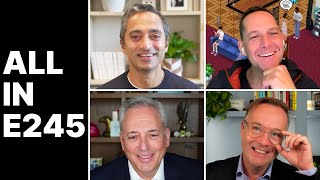
Biggest LBO Ever, SPAC 2.0, Open Source AI Models, State AI Regulation Frenzy
Episode Details
In this episode, the All-In Podcast hosts, Jason Calacanis, Chimath Palihapitiya, David Friedberg, and David Sacks, dive into several major topics shaping the tech and economic landscape. They begin by analyzing the record-breaking $55B EA Acquisition, the largest leveraged buyout ever, which saw Electronic Arts (EA) taken private by a consortium including Silverlake, the Saudi PIF (Public Investment Fund of Saudi Arabia), and Jared Kushner's firm, Affinity Partners. The deal, supported by financing from Jamie Diamond, is seen as a major bet on AI in Gaming as the future of the Video Games industry, with the hosts arguing that gaming's Intellectual Property (IP) is more defensible against AI disruption than other media. Andrew Wilson is slated to remain as EA's CEO. This massive deal stands in contrast to the broader concern that the Private Equity industry is struggling. The discussion then moves to the dysfunctional IPO Market, which has led to the rise of alternatives like Direct Listing and problematic trends like continuation funds. This prompts Chimath Palihapitiya to detail his new SPAC 2.0 vehicle, designed as a cheaper, more efficient public market alternative. The podcast also explores the AI Rollup Opportunity, exemplified by Josh Kushner's strategy of acquiring traditional firms and transforming them with AI. The conversation shifts to the AI arms race, covering the launch of AI-generated content apps like OpenAI's Sora App and a similar product from Meta, prompting a debate about the rise of AI-generated Content ('AI Slop'). A key focus is the rise of Open Source AI, where China is taking the lead with cost-effective models like DeepSeek and Moonshot AI's Kimmy. Chamath notes that his company, 8090, uses these models via platforms like Grock due to their performance and cost advantages, putting pressure on the United States's lead in closed-source models from companies like OpenAI and Meta's Llama. This technological race is complicated by the massive Energy Consumption for AI, driven by Data Centers which are causing grid strain in places like Virginia. Finally, the hosts tackle the 'regulatory frenzy' of State AI Regulation. They express deep concern over a patchwork of laws, highlighting California's California SB53 and Colorado's Colorado SB24-205, which introduces the concept of Algorithmic Discrimination. They argue this could lead to the rise of Woke AI and advocate for a single Federal AI Regulation established through Federal Preemption for AI to prevent economic fragmentation and maintain US competitiveness against China.
Key Topics & People
.jpg?width=300)


Podcast host, scientist, and newly appointed member of PCAST.
Podcast host, investor, and newly appointed co-chair of PCAST.
.jpg?width=300)
Podcast host and tech investor discussing consumer AI trends.
Investment sector increasingly focused on AI rollups and change management.

The podcast featuring the interview on longevity, psychedelics, and technology.
Facilities housing vast amounts of compute and GPUs.


The leading nation in AI innovation striving to avoid restrictive regulations that slow technological diffusion.

US state facing government fraud issues and proposing a wealth tax on billionaires.
The environment for initial public offerings, currently described as being in a drought.
The sovereign wealth fund of Saudi Arabia, responsible for significant foreign investments including allocating capital to Jared Kushner.

Son-in-law and former senior advisor to Donald Trump, criticized for securing a massive investment from Saudi Arabia.
An alternative method for companies to go public without traditional bank underwriters, discussed as potentially superior to traditional IPOs.
The Chinese company that developed the powerful open-source model Kimi K2.5, raising questions about the security and reliability of using foreign-developed models for critical applications.
The proposed solution to the patchwork of state laws, advocating for a single, lightweight national framework to govern AI, promoting consistency and innovation.

A private equity firm founded by Jared Kushner after leaving the White House, focused on global growth investing and using investments to bring countries closer together.
CEO of JP Morgan, mentioned by Tucker Carlson as an example of an out-of-touch elite for his nonsensical support of Nikki Haley.
The movement and development of AI models with publicly accessible source code, such as Llama and Mistral, which are seen as a major competitive threat to closed-source models.
A co-host of the All-In podcast, mentioned in the introduction as a potential winner of the 'bestie poker freeze out game'.

A regulatory concern where AI models might produce biased or harmful outputs against protected groups. This is seen as the mechanism through which states might enforce DEI principles in AI.
A proposed policy to establish a single, national framework for AI regulation, overriding state-level laws. It is advocated as a way to prevent ideological capture by blue states and to maintain US competitiveness.
A potential patchwork of 50 different state-level regulatory regimes for AI in the US, which is seen as a significant hurdle for American AI companies compared to China's unified approach.
A private equity firm that partnered with Endeavor to acquire IMG.
A key business asset whose value is being questioned in the age of AI, though gaming IP is considered more defensible than other content.
The significant and growing demand for electricity driven by AI data centers, which is raising concerns about grid stability and rising energy costs for consumers.
The CEO of Electronic Arts (EA), who is set to remain in his role after the company is taken private.
An AI regulation bill in California that focuses on transparency and safety reporting for the most advanced 'frontier' AI models.
An AI law passed in Colorado that bans 'algorithmic discrimination,' defined as unlawful differential treatment or disparate impact on protected groups.
A term used to describe the mass production of content using AI, raising questions about its quality and impact on media.
Jared Kushner's brother and founder of Thrive Capital, who is executing an AI rollup strategy with CPA firms.
A business strategy involving the acquisition of traditional, non-tech businesses and applying AI to transform their operations and economics, creating significant value.
The use of artificial intelligence to create more dynamic, engaging, and personalized experiences in video games, seen as a major thesis for the EA acquisition.
Described as an 'anchor pillar of usage across the entire internet' and a key area for investment and AI-driven innovation.
A major video game company that is being taken private in a $55 billion deal, the largest LBO in history.
The largest leveraged buyout (LBO) in history, where video game company Electronic Arts (EA) was taken private by a consortium of investors.

A mechanism in private equity and venture capital where a fund sells its assets to a newly created fund, effectively resetting the investment clock without a traditional exit.