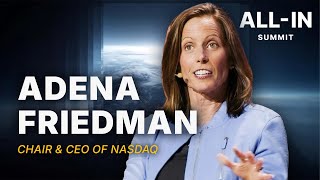
The New Era of the Stock Market with Nasdaq CEO Adena Friedman | All-In Summit 2025
Episode Details
During the All-In Summit, host Jason Calacanis interviewed Nasdaq CEO Adena Friedman about the future of capital markets. Friedman detailed how Nasdaq has evolved from a stock exchange into a global technology company providing market infrastructure and anti-financial crime solutions. The centerpiece of the discussion was Nasdaq's announcement to integrate Tokenized Securities into its core markets, a move aimed at streamlining inefficient Post-trade processing and embracing blockchain technology from the Crypto world. This initiative, along with a shift towards 24/5 Trading, is designed to modernize markets for a global audience. Friedman also addressed the significant burdens of the current IPO Market, which contributes to the trend of companies like Uber, Stripe, and SpaceX Staying private longer, thereby concentrating wealth creation in Private Markets. She advocated for reforms and alternative avenues to the Public Markets, such as the Direct Listing model used by Spotify and the use of SPVs. The conversation highlighted the critical need for Regulatory Clarity to allow institutional players into the Crypto space, noting a positive, forward-leaning stance from the SEC under Chair Atkins and collaboration with the CFTC. With clear rules, Nasdaq could potentially compete with exchanges like Coinbase, Binance, and OKX. Drawing from her role on the board of the New York Fed, a part of The Fed, Friedman affirmed her belief in Fed Independence, its data-driven nature, and the enduring strength of the US Dollar as the global reserve currency. She noted that lessons from the Great Financial Crisis continue to shape how regulators view Systemic Risk. Finally, she commented on broader trends, including the dominance of Index Investing and how Options Markets serve as complex prediction markets.
Key Topics & People


The financial market environment for initial public offerings, predicted to see a massive boom in 2026.

.jpg?width=300)
Podcast host and tech investor discussing consumer AI trends.


An annual flagship event organized by the hosts of the All-In Podcast, featuring elaborate parties and prominent sponsors.
An alternative method for companies to go public without traditional bank underwriters, discussed as potentially superior to traditional IPOs.

Investment opportunities in non-publicly traded companies. Cathie Wood believes retail investors are unfairly excluded from these markets and that the rules should be reformed.

Traditional securities that are represented as digital tokens on a blockchain. They are one of the three asset classes that can be traded under the Regulation Super App framework.

A passive investment strategy that attempts to track the performance of a broad market index, such as the Nasdaq 100. It has grown in popularity, making investing more accessible but also concentrating capital.
The risk of collapse of an entire financial system or market, as opposed to risk associated with any one individual entity, group or component of a system.
Financial markets for trading options, which are contracts giving the buyer the right, but not the obligation, to buy or sell an underlying asset at a specified price. Adena Friedman likens them to prediction markets.

A subsidiary of Nasdaq that facilitates secondary transactions for private companies. It operates on an 'issuer first' model, partnering with companies to manage liquidity events.
The Federal Reserve Bank of New York. Adena Friedman serves on its board, and she discusses its data-driven, apolitical nature and views on the US dollar and systemic risk.
The set of procedures that occur after a trade is executed, including clearing and settlement. Tokenization is seen as a technology that can streamline this process and reduce friction.
The establishment of clear rules and regulations, particularly for new industries like cryptocurrency. Its absence has held back institutions like Nasdaq from fully entering the crypto market.
Financial markets where securities are bought and sold by the general public. Adena Friedman emphasizes their importance for allowing all citizens to own a part of the economy.
A trading schedule that operates 24 hours a day, five days a week. Nasdaq is moving towards this model for US equities to cater to global investors.
The Chairman of the SEC, described as forward-leaning and wanting to 'make IPOs great again' and embrace the crypto ecosystem.

CEO of Nasdaq, who has transformed the company into a global technology powerhouse. She also serves on the board of the New York Fed.
The severe, worldwide economic crisis of 2008-2009, mentioned as a reference point for understanding systemic risk and the need for bank capitalization.
The principle that the central bank (the Federal Reserve) should be able to make long-term, data-driven monetary policy decisions free from short-term political pressure.
A trend where successful technology companies like Uber, Stripe, and SpaceX remain private for many years, capturing most of their growth for private investors.