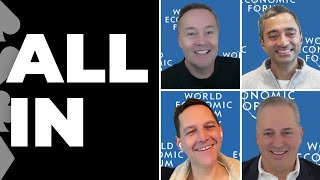
E162: Live from Davos! Milei goes viral, Adam Neumann's headwinds, streaming's broken model & more
Episode Details
In this episode, the All-In Podcast hosts Jason Calacanis, Chamath Palihapitiya, David Sacks, and David Friedberg critique the World Economic Forum in Davos as an out-of-touch, elitist event increasingly mocked amid rising global Populism. They highlight the viral speech by Javier Milei, the new president of Argentina, who delivered a powerful denunciation of Collectivism and Socialism while championing Free Markets. His speech, along with comments from Jamie Diamond defending Donald Trump's economic policies, signaled a rejection of the Davos consensus. The conversation then pivots to market failures within the United States, using Boeing as a prime example of Regulatory Capture in an airline industry Duopoly with Airbus. The persistent safety issues with the Boeing 737 Max, regulated by the FAA, are cited as evidence of a system rotting from a lack of competition. The hosts also dissect the business headwinds facing Adam Neumann's new real estate venture, Flow, which received a massive investment from Andreessen Horowitz, a major Venture Capital firm. Neumann's troubles are attributed to repeating past mistakes made at wework, specifically a flawed financial strategy involving Real Estate Investing at the market peak with risky Floating rate debt as Interest Rates soared. This leads to a broader discussion on business models, distinguishing between a true Software Business Model with high Gross Margins and a Tech-enabled Business Model. David Sacks contrasts the difficult economics of a B2C Subscription Business with the more robust B2B SaaS model, referencing the Rule of 40 as a key metric. The broken economics of the Streaming Industry are also examined, focusing on the massive problem of Subscriber Churn affecting services like Peacock and Disney+. While Netflix has built a moat with its content library, strategies like exclusive NFL games and Bundling, as seen with YouTube TV, are explored as potential survival tactics. Finally, David Friedberg's science segment delves into the alarming findings about Microplastics. He explains how PET plastics from beverage bottles break down into hundreds of thousands of nanoparticles per liter, discussing the potential Health Risks of Plastics and their broad Environmental Impact of Plastics, while noting that Biodegradable Plastics may offer a future solution. Throughout the episode, the role of the US Government is critically analyzed, both for distorting markets and failing to foster true competition.
Key Topics & People

President of the United States facing declining approval ratings due to the ongoing conflict in Iran.

Strategy of using government regulation to create moats against competitors.
.jpg?width=300)
Podcast host, investor, and organizer of the All-In Liquidity Conference.

Podcast host, scientist, and newly appointed member of PCAST.
Podcast host, investor, and newly appointed co-chair of PCAST.
.jpg?width=300)
Podcast host and tech investor discussing consumer AI trends.

The podcast featuring the interview on longevity, psychedelics, and technology.

The leading nation in AI innovation striving to avoid restrictive regulations that slow technological diffusion.
Private financing for startups, driving major economic value but restricted from public participation.

A prominent venture capital firm that published data on IPO returns.


A crucial monetary policy tool that balances economic growth against the burden of debt service.


An annual meeting in Davos, which was discussed as having a more business-centric and Trump-focused atmosphere this year, featuring notable speeches and events.
_call_on_the_Prime_Minister,_Shri_Narendra_Modi,_in_New_Delhi_on_January_15,_2016_-_cropped.jpg?width=300)
The co-founder of WeWork. His 'brilliance' is sarcastically noted for convincing investors to pour billions into tenant improvements under the guise of it being a software business.
The federal governing body of the United States, whose various departments (Commerce, Treasury, etc.) are instrumental in executing the economic policies discussed.
CEO of JP Morgan, mentioned by Tucker Carlson as an example of an out-of-touch elite for his nonsensical support of Nikki Haley.
The potential negative health impacts from consuming microplastics. While current studies show no direct carcinogenicity, there are concerns that these particles can cross the blood-brain barrier, accumulate in cells, and disrupt cellular functions, potentially causing inflammation and other issues.
Plastics that can be decomposed by the action of living organisms. This is mentioned as a promising area of research and a potential long-term solution to the environmental problems caused by conventional plastics.
The negative effects of plastic production and waste on the environment, including ocean pollution. The podcast also notes the trade-offs, as plastics have a lower carbon footprint for production and are cheaper than alternatives like glass, which has contributed to their widespread adoption.
A type of polymer commonly used for beverage bottles. These plastics can break down into micro- and nanoparticles that then contaminate the liquid inside, leading to human consumption.
The rate at which customers cancel their subscriptions. This is identified as the major problem for the streaming industry, with some services seeing monthly churn rates as high as 12%, forcing them to constantly reacquire their entire user base.

A heuristic for evaluating the health of a SaaS company, stating that its growth rate plus its operating margin should equal or exceed 40%. It provides a balanced view of growth and profitability.
The market for on-demand video services. The podcast discusses its broken model, characterized by massive content overspending, high subscriber churn, price hikes, and an impending wave of consolidation.
A business model where consumers pay a recurring fee for a product or service. David Sacks argues these are fundamentally difficult businesses due to high monthly churn rates (5-10%), requiring constant re-acquisition of customers.
A business model for traditional industries that use technology to improve operations, but whose core economics are not those of a pure software company. The podcast cautions investors against confusing these with high-margin software businesses.
A business model characterized by high gross margins (typically 80-90%) because the cost of delivering an additional unit of the product is near zero. This is contrasted with tech-enabled businesses that have significant physical costs of goods sold.
A type of loan where the interest rate varies over time based on a benchmark rate. Adam Neumann's use of this for Flow's properties is highlighted as a critical financial mistake as interest rates have spiked, making debt payments unsustainable.
The practice of purchasing property as an investment. The podcast emphasizes that in real estate, the purchase price and capital structure are often more critical to success than operational excellence, a lesson Adam Neumann has struggled with.

A model of aircraft from Boeing that has been plagued with significant safety issues, including fatal crashes due to software flaws (MCAS) and a recent incident where a door plug blew off mid-flight.
The percentage of revenue left after subtracting the cost of goods sold (COGS). The podcast uses this metric to differentiate between pure software businesses (high gross margins) and tech-enabled businesses (lower gross margins).
_-_The_Noun_Project_-_black.svg?width=300)
An economic and political theory criticized by Javier Milei at Davos. He argues it inexorably leads to socialism and poverty, and that Western elites have been co-opted by this vision.

Tiny plastic particles that are now found in many consumer products, including bottled water. A recent study found hundreds of thousands of these particles in a single liter of water, raising concerns about their health effects.

A streaming television service that offers live TV from major broadcast and cable networks. It is highlighted as a successful example of rebundling the unbundled cable package in a more user-friendly, internet-native format.
A strategy of combining multiple products or services into a single package. This is discussed as a potential solution for the streaming industry's churn problem, with examples like YouTube TV, Apple One, and The New York Times' digital subscription.

An economic system advocated by Javier Milei, which he credits for lifting 95% of the world's population out of extreme poverty since 1800. The podcast discusses it as the solution to problems caused by government intervention.

The new president of Argentina who gave a viral speech at the World Economic Forum denouncing collectivism and socialism, and advocating for free-market capitalism.