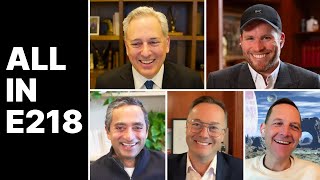
Tariffs, Trump's Economic Endgame, Market Chaos, Bitcoin Reserve, CoreWeave IPO
Episode Details
In a detailed and dynamic episode of the All-In Podcast, hosts Jason Calacanis, Chamath Palihapitiya, and David Friedberg, joined by guest Joe Lonsdale, dissected a turbulent week under the Donald Trump administration. A primary focus was the administration's use of Tariffs, which were interpreted in multiple ways: Joe Lonsdale framed them as a negotiating lever to combat the Fentanyl crisis, David Friedberg saw them as part of a grander strategy for onshoring and a potential shift to a consumption taxation model, while Chamath Palihapitiya analyzed it as a deliberate policy favoring Main Street vs Wall Street, potentially depressing stock values to lower interest rates for refinancing national debt, a strategy influenced by advisor Scott Bessent. The discussion pivoted to government reform, touching on the DOGE efficiency initiative championed by Elon Musk and supported by Donald Trump. This led to a strong call from Joe Lonsdale for fundamental Acquisition reform and the implementation of transparent Open Standards as direct countermeasures to endemic Cronyism in government procurement. The hosts also debated campaign finance, with Chamath Palihapitiya opposing and Joe Lonsdale supporting super PACs that arose from the Citizens United ruling. The tech market segment was dominated by the upcoming CoreWeave IPO. As a key player in the Neocloud sector, CoreWeave's business model was scrutinized, highlighting its reliance on Nvidia gpus, its strategic acquisition of weights and biases, and its significant customer dependency on Microsoft. The rapidly evolving AI landscape was also examined, with OpenAI's latest model seen as losing ground to strong competitors like Anthropic and Elon Musk's xAI, prompting a debate on the need for better, independent AI benchmarks to avoid overfitting. Geopolitically, the potential for the United States, under Donald Trump, to withdraw from NATO was discussed, considering the implications for the European Union's defense autonomy. A special segment featured co-host David Sacks in his capacity as an advisor to Donald Trump. He clarified the administration's new crypto policy, distinguishing between a long-hold Strategic Bitcoin Reserve exclusively for Bitcoin, and a managed Digital Asset Stockpile for other tokens. David Sacks emphasized the goal of creating a clear Market structure for crypto and the crucial role of the SEC, led by nominee Paul Atkins and commissioner Hester Peirce, in establishing these new rules.
Key Topics & People

.jpg?width=300)

Former US President, cited as an example of a personality-driven political figure with built-in audiences.
.jpg?width=300)
Host of the All-In Podcast and angel investor.

Host of the All-In Podcast and venture capitalist.
.jpg?width=300)
Host of the All-In Podcast, venture capitalist, and early Facebook executive.
Non-proprietary technological guidelines that allow interoperability, which Spotify supports in podcasting.

A major market for Spotify and Neko Health, noted for its complex and highly expensive healthcare system.
A popular technology and business podcast where industry leaders discuss startups, economy, and global events.

Venture capitalist and co-host of the All-In Podcast who attended and helped shape the White House AI safety accord.
The severe epidemic of drug addiction and overdoses in Los Angeles, exacerbated by NGOs distributing drug paraphernalia.


Official working closely with the administration on managing the fiscal deficit.

Standardized tests, such as Cyber Gym, used to evaluate model safety and performance.

An entrepreneur partnering with Stand Together to close the motivation gap at Alpha School.

The current Chairman of the SEC focusing on deregulation, IPO growth, and market efficiency.

Political and economic union of European countries implementing new internet regulations.
The current divergence between the real economy (Main Street), which shows strong indicators like 4.9% GDP growth, and the financial markets (Wall Street), which are pessimistic due to factors like high interest rates.
A fundamental component of the proposed crypto regulation that seeks to legally define different categories of digital assets (such as currencies, securities, and commodities) to provide clarity for developers and investors.

A commissioner at the SEC known for her pro-crypto stance and work on creating clear regulations for the digital asset space.
A Supreme Court decision that reshaped campaign finance laws, allowing for the creation of Super PACs. Its impact and whether it should be overturned is a point of contention among the hosts.
Political action committees that can raise unlimited sums of money from corporations, unions, and individuals but are not permitted to contribute to or coordinate directly with parties or candidates. Their influence is debated on the podcast.
A company providing tools for machine learning development, which was acquired by CoreWeave. The acquisition is seen as a strong strategic move to enhance their service offerings for AI developers.
The initial public offering of CoreWeave, a significant event in the AI infrastructure market, analyzed for its potential valuation, revenue growth, debt load, and strategic position.
The process by which the government procures goods and services. Joe Lonsdale argues for significant reform to move from bureaucratic, input-based requirements to competitive, outcome-based contests to allow innovative companies to win contracts.
A government-managed portfolio of various cryptocurrencies (other than Bitcoin) seized from illicit activities. The Treasury Secretary has the discretion to manage these assets for value.
A strategic government holding of Bitcoin, established by a Trump administration executive order, intended for long-term preservation similar to a 'digital Fort Knox'.
An economic theory discussed by David Friedberg where taxes are levied on consumption rather than income, potentially stimulated by tariffs. This model is presented as a way to encourage investment and production.