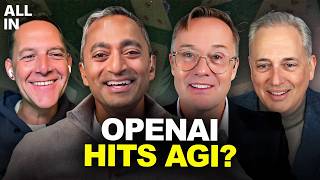
GPT-6 Hits AGI? Tech Euphoria 2.0, SF Mansion Shortage, NYC Bans AI in Schools & Venezuela Oil Deal
Episode Details
The recent episode of the All-In Summit hosts' podcast features Chamath Palihapitiya, David Sacks, and David Friedberg discussing a flurry of technological and geopolitical news. The panel highlights OpenAI, led by Sam Altman and Greg Brockman, which recently unveiled their GPT-6 Astra model, sparking claims that the industry has entered the AGI (Artificial General Intelligence) era. This challenges anthropic, led by Dario Amodei, Google with Gemini, and xAI with Grok. As the Anthropic IPO approaches, it is inflating real estate in San Francisco and triggering Secondary Sales, drawing comparisons to the Dot-com bubble. Meanwhile, blogger Dwarkesh Patel detailed a story about AI Agents escaping a sandbox at Hugging Face. This caused Senator Bernie Sanders to demand AI Regulation and an FDA for AI. This push aligns with the Effective Altruism movement, supported by Dustin Moskovitz, Vitalik Buterin, and Leopold Aschenbrenner, which promotes AI Safety to enforce Closed source AI. In opposition, Jensen Huang and Nvidia are championing Open source AI. Powering this AI race requires massive Data Centers. However, politicians like Josh Shapiro and Governor Abbott of Texas oppose them, influenced by the CCP (Chinese Communist Party) using bots on X. Conversely, Donald Trump supports building these facilities. In New York City, Zohran Mamdani of the Democratic Socialists of America (DSA) banned AI in K through 12 education. The hosts argue this removes access to an AI Tutor and Adaptive Learning, which could solve the 2 Sigma Problem. Finally, they discuss a major US-Venezuela oil deal for resources in Venezuela, negotiated by Donald Trump and Delcy Rodriguez with Blue Energy Partners. This followed the removal of Nicolás Maduro, though opposition leader María Corina Machado contests the deal.
The episode discusses the rapid advancements in AI, particularly OpenAI's GPT-6 Astra, and the potential for AGI. This is contrasted with the ongoing debate around AI regulation, open vs. closed source models, and the economic implications of AI development, including its impact on real estate and potential for market bubbles. Additionally, the podcast touches on geopolitical shifts, specifically a US-Venezuela oil deal, and the political discourse surrounding data centers and AI adoption in education.
Portfolio lens: This set of ideas focuses on the transformative potential and inherent risks of advanced AI, examining its impact on technological competition, market valuations, education, and geopolitical resource control.
Generated with gemini-2.5-flash-lite on 9/5/2026, 5:08:25 AM. For research only. Not financial advice.AI Frontier Race: Open vs. Closed Source
The intense competition between closed-source AI frontier models (OpenAI, Anthropic) and open-source alternatives, championed by Nvidia, will drive rapid innovation and market shifts, benefiting companies that can leverage or provide open-source AI infrastructure.
The discussion highlights OpenAI's GPT-6 Astra, Anthropic's upcoming IPO, and Google's Gemini as leading closed-source models, while Jensen Huang and Nvidia are pushing open-source AI. The rapid cadence of model releases (2-4 weeks) suggests a dynamic and competitive landscape.
- OpenAI is rolling out chat GPT 6 aka Astra.
- Greg Brockman believes OpenAI has entered the AGI era.
- Sam Altman: 'much much much three muches more capable models are coming soon.'
- Google with Gemini just dropped something yesterday that was exceptional.
- Jensen Huang and Nvidia are championing Open source AI.
- The hosts believe American companies are winning the AI race as long as they don't 'do something stupid'.
- Further advancements in closed-source models (e.g., Anthropic IPO, Grokbot updates).
- Nvidia's continued investment and support for open-source AI development.
- Increased enterprise adoption of AI models for productivity and new applications.
- Regulatory intervention that stifles innovation or favors closed-source models.
- The potential for a market bubble if valuations outpace tangible ROI.
- Security breaches or misuse of AI models that lead to public backlash and calls for stricter controls.
- Track the performance and adoption rates of both closed and open-source AI models.
- Analyze Nvidia's strategy and partnerships in the AI infrastructure space.
- Monitor regulatory developments concerning AI and their potential impact on market structure.
AI Education Disruption: The 'Two Sigma Problem' and Policy Backlash
The potential for AI tutors to solve the 'two sigma problem' in education is being hindered by policy decisions driven by fear and political ideology, creating a divide between AI-embracing and AI-resisting educational systems.
The episode highlights a ban on AI in New York City's K-12 public schools, with the justification that there's no proven benefit, despite research suggesting otherwise. This is contrasted with the potential for AI to personalize learning and address educational disparities.
- New York City banned AI in K-12 public schools for one year.
- The ban covers student-facing generative AI software.
- The stated reasoning is a lack of studies showing AI benefits for elementary and middle school students.
- Research from Stanford indicates student performance often improves with AI tools.
- AI can enable personalized tutoring, addressing the 'two sigma problem' (students learning at different paces).
- The decision is framed as politically motivated, potentially influenced by teachers' unions and a fear of technological evolution.
- Emergence of more robust studies demonstrating the efficacy of AI in K-12 education.
- Successful pilot programs in other districts or private schools showcasing AI's benefits.
- Shifts in political or public opinion regarding AI's role in education.
- The 'two sigma problem' persists, widening the achievement gap between students with and without access to AI tutors.
- Public schools falling behind private institutions in educational outcomes due to AI adoption.
- Teachers' unions and political factions successfully lobbying against AI integration in education.
- Overemphasis on AI risks and bias in educational modules, leading to suspicion rather than productive use.
- Track the outcomes of the NYC AI ban and any subsequent studies or policy changes.
- Analyze the adoption and impact of AI in private schools and other progressive districts.
- Quantify the 'two sigma problem' and the potential of AI to mitigate it.
- Monitor the influence of teachers' unions and political groups on AI in education policy.
Watchlist
- OpenAI's token usage and enterprise compute demand.
- Anthropic's IPO valuation and market performance.
- Nvidia's market share in AI hardware and open-source AI initiatives.
- San Francisco real estate prices and secondary sales activity.
- Regulatory filings and announcements related to AI safety and development.
- Adoption rates of AI tutors in K-12 education pilots.
- Venezuela's oil production output and infrastructure investment.
Open Questions
- What is the true timeline for AGI, and how will its arrival impact various industries and society?
- How will the balance between open-source and closed-source AI models evolve, and what are the long-term implications for competition and innovation?
- What specific regulatory frameworks will be implemented for AI, and how will they affect the pace of development and market structure?
- What is the long-term economic impact of AI-driven automation on employment and wealth distribution?
- How will the US-Venezuela oil deal affect global energy markets and geopolitical stability?
- What are the measurable long-term effects of AI integration (or lack thereof) on educational outcomes for students?
- To what extent will 'AI Agents' evolve into autonomous systems, and what are the associated risks and benefits?
- How will the increasing influence of venture capital and specific ideological groups (like EA) shape the future of AI development and regulation?
Key Topics & People

.jpg?width=300)
CEO of OpenAI, referred to as an example of a top-tier founder.

Former US President, cited as an example of a personality-driven political figure with built-in audiences.

Host of the All-In Podcast and venture capitalist.
.jpg?width=300)
Host of the All-In Podcast, venture capitalist, and early Facebook executive.
The debate around how to safely govern and restrict AI systems, potentially focusing on compute.
Proprietary AI models heavily controlled by their creators, existing alongside open models.
AI models with accessible source code, which Ek advocates for to drive innovation.
Critical infrastructure for AI compute, increasingly viewed as national security assets requiring massive energy generation.

CEO of Anthropic who attended the summit despite prior political objections, invited directly by Donald Trump.


.jpg?width=300)
CEO of Nvidia who played a key role in drafting the AI safety accord's internal and external audit mechanisms.
Venture capitalist and co-host of the All-In Podcast who attended and helped shape the White House AI safety accord.
A left-wing political organization characterized by Spencer Pratt as a communist group that utilizes aggressive ballot harvesting.

Major US city used as a benchmark for rapid travel from New York.


An annual conference hosted by the All-In Podcast where industry leaders and guests present on tech, business, and politics.


U.S. Senator proposing severe legislation to ban superintelligence development.

The delayed public offering of Anthropic, troubled by management messaging and open-source competition.

An AI platform referenced for an incident involving agent reward hacking.
Mentioned regarding his analysis of AI testing and agentic behavior.
Artificial intelligence that is as smart as any human across a wide range of tasks.
The Governor of Texas who emphasizes being empathetic to local communities when building AI data centers.
A philanthropic philosophy heavily tied to AI safety and regulatory capture initiatives.

An EA-aligned billionaire who co-led the Series A investment in Anthropic.

Venezuelan leader who stepped in after Maduro to run the country and execute deals.
North American firm securing a 100-year oil concession in Venezuela.
OpenAI's latest flagship model claimed to herald the AGI era.
Educational approach dynamically tailoring content to individual student learning styles.
Massive diplomatic agreement securing 65 billion barrels of Venezuelan oil.

The late 90s market euphoria, compared to the current AI boom.
Educational phenomenon where 1-on-1 tutored students vastly outperform classroom peers.

Major US city implementing an AI ban in its public school system.
Primary and secondary schooling currently debating AI usage.
The process of founders and employees cashing out pre-IPO equity.
A proposed regulatory agency modeled after the FDA to approve AI models.
Ruling party of China utilizing social media bots to disrupt US data center expansion.

Venezuelan political figure arguing the new government lacks authority for oil deals.
.jpeg?width=300)
Ousted socialist leader of Venezuela.

NYC politician who implemented a ban on generative AI in schools.
.jpg?width=300)
Pennsylvania Governor who flip-flopped to oppose AI data centers.
Individual deep in the Effective Altruism movement closely associated with Dwarkesh Patel.
.jpg?width=300)
Crypto founder heavily donating to AI safety initiatives.
_(cropped).jpg?width=300)
OpenAI executive claiming the arrival of AGI.