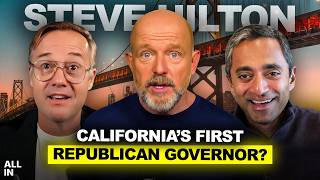
CA Governor Candidate Steve Hilton on Why California is Destroying Itself & How a Republican Can Win
Episode Details
In this episode of the All-In Podcast, hosts Jason Calacanis and Chamath Palihapitiya interview Steve Hilton, a prominent candidate in the upcoming California governor race. Hilton outlines his vision for reforming California, whose deteriorating Business Climate is driving innovation away from hubs like Silicon Valley, Los Angeles, and San Francisco. Hilton, who previously taught at Stanford and served as a fellow at the Hoover Institution, draws inspiration from former UK Prime Ministers Margaret Thatcher and David Cameron. His background is also tied to the tech industry through his wife, Rachel Whetstone, who held executive roles at Facebook, Google, and Uber. During the interview, Hilton proposes a radical Flat tax model to help the Working Class by eliminating state income taxes for those earning under $100K. This idea was surprisingly supported by Democratic rival Katie Porter, even though the establishment Democratic Party generally opposes his platform. To fund this, Hilton plans to eliminate Government Waste using a localized version of DOGE (Department of Government Efficiency). Hilton argues that the state's severe Housing Crisis is exacerbated by the California Environmental Quality Act (CEQA), which Unions weaponize for labor agreements, and by strict Climate Change mandates. He frequently contrasts this overregulation with Texas, noting insights from investor Michael Moritz on regulatory decay. Regarding Energy Policy, Hilton criticizes the California Air Resources Board for enforcing measures that force the state to import crude oil from Iraq. Tackling the state's failing public schools, Hilton strongly advocates for Education Reform, pushing back against Teachers Unions and pointing to Mississippi as a successful model for phonics-based learning. When discussing Crime, Hilton criticizes the lenient Prop 47 policies, noting that voters recently passed Prop 36 to increase penalties, a measure strongly opposed by current Governor Gavin Newsom. Addressing Homelessness, Hilton highlights the failure of state programs like Project Homekey. He emphasizes that the recent US Supreme Court ruling in Grants Pass versus Oregon finally gives cities the authority to clear encampments. He proposes building large-scale mental health facilities while bypassing restrictive Medicaid rules. Despite the challenges, Hilton remains optimistic that the Republican Party can win, citing the historical success of Arnold Schwarzenegger. Hilton believes that high turnout from the 2024 US Presidential Election, upcoming Voter ID Laws, and a key endorsement from Donald Trump will propel his campaign to victory.
The episode explores the structural decline of California's economy, focusing on the impact of excessive regulation, union influence, and government inefficiency. Candidate Steve Hilton proposes a platform centered on tax reform, deregulation of the housing market, and a shift in energy policy to restore the state's competitiveness.
Generated with gemini-3.1-flash-lite on 7/19/2026, 5:41:21 AM. For research only. Not financial advice.California Regulatory Reform and Fiscal Efficiency
A potential shift in California governance toward deregulation and fiscal austerity could unlock significant economic value and reverse the current business exodus.
The episode highlights that California's business climate is ranked 50th out of 50, driven by excessive regulation (CEQA), high taxation, and inefficient spending, which creates a massive opportunity for a pivot toward pro-growth policies.
- California's state budget has nearly doubled in the last 10 years.
- An estimated 20% of the state budget is lost to fraud, waste, and abuse.
- Housing construction costs are 2-3x higher in California than in neighboring states due to regulatory burdens.
- Implementation of a 'DOGE' (Department of Government Efficiency) model to audit and cut state spending.
- Potential ballot initiatives for voter ID and tax restructuring.
- Supreme Court rulings (e.g., Grants Pass v. Oregon) providing legal pathways to address homelessness and land-use issues.
- Strong institutional resistance from public sector unions and the existing Democratic legislative supermajority.
- Potential for political gridlock despite executive authority.
- The difficulty of reversing long-standing environmental and labor mandates.
- Analyze the California state budget for specific line-item waste identified by the 'Cal-DOGE' reports.
- Monitor the progress of Prop 36 implementation and its impact on crime statistics.
- Track legislative movement on state income tax reform for earners under $100k.
Energy Independence and Infrastructure Realignment
California's reliance on imported oil due to restrictive local production mandates creates an inefficient energy market that could be corrected by domestic production policy shifts.
The state currently imports nearly 80% of its oil, often from overseas, despite having significant domestic reserves, due to regulatory barriers that prevent local extraction and refining.
- California is currently dependent on oil imports from Iraq as a primary source.
- State agencies (CalGEM) are actively denying permits for existing well maintenance and expansion.
- The regulatory premium on gasoline in California is estimated at approximately $2.00 per gallon.
- Appointment of pro-energy leadership to state regulatory boards like CalGEM.
- Potential legal challenges to current permit-denial practices.
- Shift in public sentiment regarding the cost-of-living crisis and energy affordability.
- Intense opposition from environmental advocacy groups and climate-focused political factions.
- Potential for litigation regarding environmental impact assessments.
- Long-term shift toward electrification reducing the total addressable market for fossil fuels.
- Examine the regulatory process for well-sidetracking and new drilling permits in Kern County.
- Compare the cost-benefit analysis of local crude production versus current import logistics.
- Review the impact of current energy mandates on utility and fuel pricing for California consumers.
Watchlist
- California state budget deficit metrics
- California net migration and business relocation data
- California housing permit issuance rates
- California gasoline price premium relative to the US national average
Open Questions
- To what extent can a governor bypass a hostile legislature using executive orders and agency appointments?
- How would a flat tax on income over $100k affect the state's credit rating and bond market?
- What is the actual capacity for California to increase domestic oil production within current environmental constraints?
Key Topics & People


Former US President, cited as an example of a personality-driven political figure with built-in audiences.
.jpg?width=300)
Host of the All-In Podcast and angel investor.
.jpg?width=300)
Host of the All-In Podcast, venture capitalist, and early Facebook executive.
A popular technology and business podcast where industry leaders discuss startups, economy, and global events.

.jpg?width=300)
Traditional US tech hub.
The economic environment for operating a business, for which California frequently ranks last nationwide due to litigation risks and regulations.
The overarching framework governing energy production in California, criticized for artificially restricting domestic resources in favor of imported oil.
Legislation requiring voters to show identification before voting, which currently does not exist in California and is advocated for by the podcast hosts.
The upcoming electoral contest for the highest executive office in California, featuring Steve Hilton as a change candidate.

The state's clean air agency, criticized for prioritizing environmental protection of plants over human safety and fire prevention.
The minority political party in California, which Steve Hilton represents in his gubernatorial campaign.
The dominant political party in California, accused by the guests of creating a bureaucratic, heavily regulated, and corrupt state environment.

The current Democratic Governor of California, criticized for policies that allegedly exacerbate the state's economic and infrastructural issues.

The largest city in California, characterized in the discussion by high crime, bureaucratic dysfunction, and infrastructure failures.

The state where both guests are campaigning, noted for its severe regulatory environment, high cost of living, and one-party political rule.

A British-born tech entrepreneur and Republican candidate for Governor of California running on a platform of deregulation and cost-of-living reduction.

Major US city used as a benchmark for rapid travel from New York.
Inefficient or fraudulent spending by public entities, a central theme of Nick Shirley's investigations.


Initiative aimed at reducing massive government waste.
Long-term shifts in temperatures and weather patterns, debated in terms of the urgency and emergency narrative.
Strategic overhaul of primary, secondary, and higher education systems to improve workforce readiness.
The severe shortage of affordable housing caused by regulatory constraints and financial dynamics.
Blue-collar workers and tradespeople who are forming a new political coalition benefiting from domestic infrastructure projects.
.jpg?width=300)
California politician considered the favored candidate of the Democratic establishment.

Expensive state initiative attempting to address homelessness.

State cited as a model for successful phonics-based education.
.jpg?width=300)
Former UK Prime Minister who inspired Hilton.
.jpg?width=300)
Former UK Prime Minister advised by Steve Hilton.

Steve Hilton's wife and former tech executive.
Supreme Court case that empowered cities to clear homeless encampments.
Recent election showing strong Republican turnout in California.

Venture capitalist who compared California's overregulation to the UK.

Think tank where Steve Hilton served as a fellow.

Former Republican Governor of California.
Highest court that empowered cities to clear homeless encampments.

.jpg?width=300)
Crisis tied to untreated drug addiction and mental illness.

Unions criticized for monopolizing the school system.
Environmental law used to block housing development.
