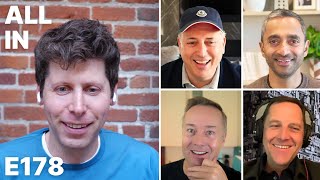
Sam Altman: Getting Fired (and Re-Hired) by OpenAI, Agents, AI Copyright issues
Episode Details
In a detailed interview on the All-In Podcast, Sam Altman, CEO of OpenAI, provided insights into the company's strategy and the broader AI landscape. He confirmed that while the industry anticipates GPT-5, OpenAI is moving towards a model of Continuous model improvement, where systems like GPT-4 are constantly upgraded, potentially making discrete version numbers obsolete. Altman addressed the critical open source vs closed source AI debate, defending OpenAI's proprietary approach for its frontier models as necessary for its mission, while acknowledging the rapid progress of open-source competitors like Meta's Llama 3. He emphasized that reducing AI cost and latency and building out a robust infrastructure of AI Chips are paramount. Looking ahead, Altman shared his vision for new hardware paradigms beyond the iPhone, referencing discussions with Jony Ive, and conceptualized AI Agents not as extensions of users, but as highly capable 'senior employees' powered by advanced Reasoning Models. A significant portion of the discussion was dedicated to the November 2023 turmoil, where Altman recounted the Sam Altman's firing and rehiring, attributing it to a fundamental culture clash with the OpenAI Nonprofit Board regarding the pace and methods for pursuing safe AGI (Artificial General Intelligence). He tackled complex legal and ethical issues like AI Copyright and Fair Use, referencing the ongoing lawsuit with The New York Times and using Taylor Swift as an example to explain the challenges of content generation at Inference Time. Regarding AI Regulation, Altman advocated for a global agency to oversee Frontier AI systems capable of Recursive self-improvement, while expressing concern about fragmented state-level legislation, such as proposals in California. He also reflected on his past research into UBI at Y Combinator, proposing that Universal Basic Compute might be a more fitting model for distributing AI's benefits. Altman concluded by expressing his personal excitement for AI's application in accelerating Scientific Discovery, an area where Google has also made significant strides with its AlphaFold 3 model, now being commercialized by its subsidiary Isomorphic Labs.
Key Topics & People


Prominent venture capital firm.

.jpg?width=300)
CEO of OpenAI, referred to as an example of a top-tier founder.
.jpg?width=300)
Host of the All-In Podcast and angel investor.
The debate around how to safely govern and restrict AI systems, potentially focusing on compute.

A popular technology and business podcast where industry leaders discuss startups, economy, and global events.

.jpg?width=300)

The state where both guests are campaigning, noted for its severe regulatory environment, high cost of living, and one-party political rule.


Artificial intelligence that is as smart as any human across a wide range of tasks.
An Alphabet subsidiary applying advanced AI to life sciences and drug discovery, led by Demis Hassabis.


Leading startup accelerator that participated in Stripe's early seed round.

A major publication actively pursuing lawsuits against AI labs over unauthorized web scraping.
Algorithm used to compress natural data into efficient representations for AI generation
The most advanced large-scale AI models available, driving current generative capabilities.

.jpg?width=300)
A chaotic week-long event where OpenAI's board fired CEO Sam Altman, leading to a massive employee backlash that resulted in his reinstatement and a restructuring of the board.
The legal and ethical issues surrounding the use of copyrighted material to train AI models and generate derivative works, a key point of debate between the hosts.

A global music superstar, named the best CEO of 2023 by Jason Calacanis for her massive economic impact through her tour, merchandise, and direct-to-theater movie release.
A key challenge for the AI industry, where current models are too expensive and slow for many production-quality applications. This creates an opportunity for new players to disrupt the market.
An open-source project that replicates the functionality of the AI software engineer demo 'Devon', cited as an example of the power of the open-source community.
The phase when a trained AI model is used to make predictions or generate content. Altman suggests the debate on AI fairness will shift from training data to what happens at inference time.
Sam Altman's framing of OpenAI's product, which is not just a set of model weights but a comprehensive, useful system for people to build on.
A strategy for AI development where models are constantly updated and improved rather than being released in discrete, numbered versions. Sam Altman suggests this is the future direction for OpenAI.
Google's AI model that can predict the structure and interactions of proteins and other molecules, representing a major breakthrough for biology and medicine.
The governing body of OpenAI, which is structured as a nonprofit. This board was responsible for the decision to fire Sam Altman, citing a need to uphold the mission of safe AGI.
An idea proposed by Sam Altman as a potential evolution of UBI, where every individual receives a slice of future AI compute (e.g., GPT-7) which they can use, resell, or donate.
A central debate in the AI industry regarding whether AI models should be publicly available (open source) or proprietary (closed source). OpenAI follows a closed-source approach for its frontier models.
An experimental fund by Sequoia Capital where individuals like Sam Altman and Jason Calacanis were given capital to make early-stage investments. It was highly successful.
A hypothetical scenario where an AI system can autonomously and rapidly improve its own intelligence, potentially leading to an intelligence explosion. This is a key concern in AI safety.
An application area for AI that Sam Altman is personally most excited about, believing AI can significantly accelerate scientific research and breakthroughs.
A key area of AI research focused on developing models that can perform complex reasoning tasks, which Sam Altman believes is a crucial missing piece for many advanced applications.