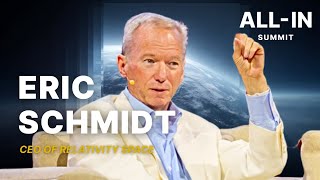
Eric Schmidt on AI, the Battle with China, and the Future of America
Episode Details
Former Google CEO Eric Schmidt presents a multifaceted worldview for founders, touching on technology, geopolitics, and business strategy. He strongly opposes Remote work for young professionals, advocating for in-person mentorship. Schmidt provides a nuanced analysis of the US vs China AI competition, explaining that while the US pursues ambitious goals like AGI (Artificial General Intelligence), China is strategically focused on applying existing AI to everything, from consumer apps to robotics, and is winning global influence by promoting Open source AI, a direct challenge to the predominantly Closed source AI approach of the West. This competition is underscored by China's intense 996 work culture and technical advances in areas like Numeric Precision in AI. On the hardware front, Schmidt discusses his leadership at Relativity Space, which builds Rockets to compete with SpaceX, and offers profound insights into the evolution of warfare based on the Ukraine War. He describes Drone warfare as a paradigm shift, where cheap Drones can neutralize expensive military assets, and where Ukraine effectively uses technologies like Starlink for command. Geopolitically, Schmidt voices concerns about the Decline of the West and global Population Decline, but ultimately champions American exceptionalism, urging the nation to leverage its unique strengths in capital markets and innovation. On the future of AI, he counters the San Francisco narrative by predicting AGI (Artificial General Intelligence) is 6-7 years away, pending breakthroughs in areas like Recursive self-improvement and Scientific Discovery, a path being pursued by Demis Hassabis with Google's Gemini model. The conversation also acknowledges other key players like Meta in the open source space, OpenAI's Sam Altman, and Google co-founder Sergey Brin.
Key Topics & People


.jpg?width=300)
CEO of OpenAI, referred to as an example of a top-tier founder.
Proprietary AI models heavily controlled by their creators, existing alongside open models.
AI models with accessible source code, which Ek advocates for to drive innovation.
.jpg?width=300)

.jpg?width=300)

Major US city used as a benchmark for rapid travel from New York.


Leader of DeepMind prioritizing reliability and alignment in frontier models.
Artificial intelligence that is as smart as any human across a wide range of tasks.


The unique freedom and individualism of the US, which Weinstein views as its greatest scientific weapon.
The ongoing geopolitical conflict which became a dividing issue among GOP candidates in the primary debate.

Co-founder of Google, referenced in discussions about the company's long-term investment vision.
A significant demographic issue threatening China's long-term economic strategy.

A modern form of combat relying on unmanned aerial vehicles, heavily invested in by startups.

Discussed by George Kurtz as a major source of cybersecurity vulnerabilities, as it has opened up new attack vectors for adversaries like North Korea to infiltrate companies.

Former CEO of Google and a former board member of Apple. His development of Android reportedly made Steve Jobs feel betrayed.
A hypothetical scenario where an AI system can autonomously and rapidly improve its own intelligence, potentially leading to an intelligence explosion. This is a key concern in AI safety.
An application area for AI that Sam Altman is personally most excited about, believing AI can significantly accelerate scientific research and breakthroughs.

The level of detail at which numbers are represented in AI model training (e.g., FP16, FP8, FP4). Chinese models are reportedly pushing for lower precision (8-bit and 4-bit) compared to the American standard (16-bit), which is a significant technical achievement.
A type of machine learning where an agent learns to make decisions by performing actions in an environment to achieve the maximum cumulative reward. Schmidt discusses its application by DeepSeek and its future role in drone warfare.
An intense work schedule (9 a.m. to 9 p.m., 6 days a week) prevalent in Chinese tech companies, cited by Eric Schmidt as a key competitive factor against the West.
The strategic rivalry between the United States and China for dominance in the field of artificial intelligence. Schmidt notes that the US focuses on AGI while China applies existing AI to various sectors like robotics and consumer apps.

An aerospace company aiming to compete with SpaceX in the low Earth orbit (LEO) satellite launch market. Eric Schmidt is an early investor and recently took over a leadership role in the company.
A thesis concerning the potential erosion of Western societies from internal social issues, such as declining birth rates and transformations in historic values.