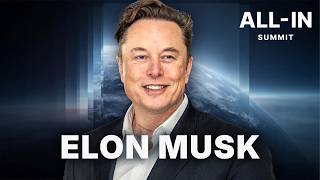
Elon Musk on DOGE, Optimus, Starlink Smartphones, Evolving with AI, Why the West is Imploding
Episode Details
During an extensive interview on the All-In Podcast, Elon Musk provided a comprehensive update on his major ventures, speaking from the Tesla Global Engineering Headquarters in Palo Alto. He began by describing his vision for Optimus, predicting it would be humanity's greatest product. As a type of Humanoid Robots, its development hinges on solving the complex 'hands problem' to replicate human dexterity and requires significant Vertical Integration because a supply chain for its advanced Actuators doesn't exist. Musk also detailed Tesla's progress in silicon, announcing the upcoming AI5 chip, which he claims offers a 40-fold improvement over the current AI4 chip. This new hardware is expected to create an order-of-magnitude leap in the performance and safety of the FSD (Full Self-Driving) system. Shifting to SpaceX, Musk outlined the strategy for Starlink to provide high-bandwidth connectivity directly to smartphones. This plan is enabled by a recent $17 billion acquisition of Wireless Spectrum from Echoar, positioning Starlink as a future competitor to traditional carriers like Verizon. He also updated on the Starship program, expressing confidence in achieving Full Reusability (Rockets) by the next year, while acknowledging that creating a durable, fully reusable Orbital Heat Shield is the primary remaining engineering challenge. For his xAI venture, Musk explained that the next generation of Grok will be trained using vast amounts of Synthetic Data to correct and enhance the world's knowledge, a process powered by the Colossus supercomputer being built in Memphis. The hosts proposed this could lead to a 'Grokipedia'. Musk noted that progress in Artificial Intelligence (AI) generally follows logarithmic Scaling Laws (AI). On a philosophical level, Musk expressed profound concern about the Decline of the West, viewing trends like low birth rates as societal suicide. He contrasted this with his personal Philosophy of Curiosity, which drives his ambition to make humanity a Multi-planetary species by establishing a self-sustaining city on Mars. The podcast's introduction also briefly acknowledged Musk's past association with the cryptocurrency DOGE.
Key Topics & People


.jpg?width=300)
The podcast hosting Governor Josh Shapiro to discuss business, politics, and the economy.
.jpg?width=300)
Artificially generated data used to efficiently train AI models.
Advanced technology contributing to job automation and global competition.
Tesla's advanced driver-assistance system that aims to handle dynamic driving tasks.

General-purpose robots with a human-like form, such as Tesla's Optimus. Gecko Robotics' CEO sees his company as a future major purchaser of these robots for high-ROI industrial tasks.
An AI-generated encyclopedia created by Grok, positioned as a more accurate, neutral, and comprehensive alternative to Wikipedia. It corrects errors, adds context, and will include AI-generated video.
A thesis concerning the potential erosion of Western societies from internal social issues, such as declining birth rates and transformations in historic values.
The significant engineering challenge of designing and building a robotic hand that can replicate the dexterity and versatility of a human hand, considered a primary difficulty in creating Optimus.

.svg?width=300)
A long-term goal articulated by Elon Musk for humanity to establish a self-sustaining presence on another planet, such as Mars, to ensure the long-term survival of consciousness.
Elon Musk's personal worldview, which centers on a desire to understand the nature of the universe and drives his ambition to expand the scope and scale of consciousness.
The principle that AI model performance improves predictably as compute power, data, and model size are scaled up. Musk suggests this follows a natural logarithmic function.
The concept of a rocket system where all major components, including the booster and the upper stage (ship), can be recovered and reused. This is the primary goal for SpaceX's Starship.
The protective layer on a spacecraft that withstands the intense heat of atmospheric reentry. Creating a fully and rapidly reusable one is a major engineering hurdle for Starship.
Radio frequencies that enable wireless communication. SpaceX acquired licenses for about $17 billion to enable its Starlink satellites to provide high-bandwidth service directly to cell phones.

A strategy where a company controls its own supply chain. Tesla must pursue this for Optimus because a supply chain for components like advanced actuators does not currently exist.
