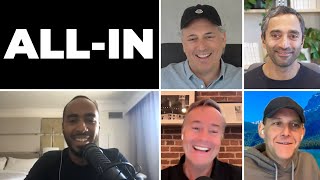
E147: TED goes woke, Canada's Nazi blunder, AI adds vision, plus: who owns OpenAI?
Episode Details
In this episode of the All-In Podcast, the hosts—Chamath Palihapitiya, David Sacks, Jason Calacanis, and David Friedberg—tackle cultural controversies and major AI breakthroughs. First, they discuss Coleman Hughes and his experience speaking at TED, led by Chris Anderson. Hughes argued for a Colorblind society but faced backlash from staff fixated on DEI (Diversity, Equity, and Inclusion). This reflects a broader trend of Institutional Capture driven by the Woke Mind Virus, similar to issues at The New York Times. Bari Weiss of the Free Press and blogger Tim Urban highlighted how TED suppressed the talk. The hosts discuss how these ideological mandates are also impacting Venture Capital. The conversation then shifts to a major gaffe in Canada, where Prime Minister Justin Trudeau and the Canadian Parliament accidentally gave a standing ovation to Yaroslav Hunka, a former Nazi, during a visit by Volodymyr Zelenskyy (Zalinsky) of Ukraine amidst the war with Russia. Chamath argues this performative virtue signaling is another symptom of the Woke Mind Virus blinding leaders. On the technology front, the Financial Times reported that OpenAI, led by Sam Altman, is in talks with former Apple designer Johnny Ive and Masayoshi Son of SoftBank to raise $1B to build the "iPhone" of AI, a huge step for Consumer AI and Hardware. David Sacks breaks down OpenAI's corporate structure, noting its unique Cap return model that benefits investors like Microsoft and early backers like Elon Musk and Vinod Khosla, while technically leaving Altman with zero equity. Finally, David Friedberg explores the future of Computing Interfaces. As OpenAI launches Multimodal Models for ChatGPT, Large Language Models (LLMs) are evolving into the core Operating System for devices, potentially threatening the traditional App Store model. This AI integration extends everywhere: Autonomous Driving is improving via reasoning models, Google is baking Google Gemini into its core apps, and note-taking apps like Reflect use AI for context. Physical integration is also accelerating, with Meta unveiling new Smart Glasses as the next generation of Wearables.
Key Topics & People
Form of private equity and financing provided to startups with high growth potential.

.jpg?width=300)
CEO of OpenAI, referred to as an example of a top-tier founder.
.jpg?width=300)
.jpg?width=300)
Host of the All-In Podcast and angel investor.

Host of the All-In Podcast and venture capitalist.
.jpg?width=300)
Host of the All-In Podcast, venture capitalist, and early Facebook executive.


.jpg?width=300)
Venture capitalist and co-host of the All-In Podcast who attended and helped shape the White House AI safety accord.

Massive AI models that require tremendous infrastructure and computing power.

A wearable device developed by Meta that includes camera, audio, and real-time translation capabilities.

Next-generation AI systems processing text, vision, and audio, driving the need for choice.
The application of AI to create self-driving vehicles that can reason about their environments.

Frameworks seeking to promote fair treatment and full participation of all people, criticized in the context of scientific grant allocations.
_on_July_11,_2008.jpg?width=300)
Founder and CEO of SoftBank.

A major publication actively pursuing lawsuits against AI labs over unauthorized web scraping.
Traditional user interfaces (UIs) that are predicted to disappear as AI agents take over backend data interactions.

AI applications designed for end-user accessibility, generating broad usage and intent signals.
President of Ukraine, leading the country's defense and seeking more military hardware from Western allies.
The foundational software of a computer or mobile device, which LLMs are now challenging and seeking to replace.

The business publication that broke the news regarding advanced talks for an AI hardware device.

Google's sophisticated suite of AI models being aggressively woven into its existing app ecosystem.

Prominent venture capitalist who supported Sam Altman and downplayed concerns over OpenAI's structural changes.
An investment model limiting the maximum return for shareholders, heavily used by OpenAI to maintain non-profit alignment.
The highly complex setup allowing OpenAI to operate a capped-profit entity under a nonprofit foundation.
Former lead designer at Apple, reportedly in talks with OpenAI to design a new consumer AI device.
A 98-year-old former SS division member mistakenly honored by the Canadian Parliament.
_(cropped).jpg?width=300)
The Prime Minister of Canada, criticized for lack of diligence and leaning heavily on performative politics.
.svg?width=300)
A media company founded as an alternative to captured legacy institutions to support open discourse.
A journalist who advocates for abandoning captured legacy institutions to start new, viewpoint-diverse organizations.
A term used by the hosts to describe an ideological contagion that forces historical revisionism and masks leadership incompetence.
The phenomenon where an institution's original ideals are co-opted by employees prioritizing specific ideological goals.
The principle of treating people without regard to their race, both personally and in public policy.
The head of TED who was caught between his invited speaker and internal staff pushback.


A writer and podcaster who gave a controversial TED talk advocating for a society that does not factor race into its core policies.