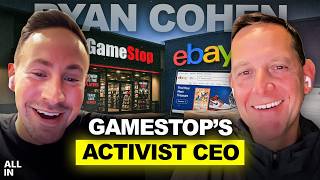
GameStop CEO Ryan Cohen’s $56B Plan to Take Over eBay
Episode Details
Sponsored by AppLovin, an episode of the All-In Podcast features host David Friedberg interviewing Ryan Cohen, the CEO of GameStop. The conversation begins with Cohen's entrepreneurial journey, detailing how Chewy, a company he founded, was built to compete directly with Amazon in E-commerce. Cohen achieved success by mastering Supply Chain logistics, managing Negative working capital, and focusing on Recurring revenue. Following the sale of Chewy, Cohen transitioned to Activist Investing. He discusses filing a 13D form with the SEC, a shift from passive 13G investing, to actively engage with GameStop management. This occurred around the time of the next Console cycle featuring new PlayStation and Xbox releases. The Wall Street Bets community propelled GameStop into the center of the Meme Stocks phenomenon. Upon becoming CEO, Cohen had to quickly learn Physical Retail operations. He initiated an aggressive Cost Cutting strategy and pivoted the company's focus toward the Collectibles market, particularly Trading cards, leveraging a strong Trade-in model. These efforts led to impressive Free cash flow and enabled Share Buybacks. The core of the discussion revolves around GameStop's $56 billion M&A bid for eBay. Cohen criticizes eBay's current Corporate Governance, noting a lack of Skin in the game among executives, and emphasizes the superiority of Founder-led companies. While acknowledging eBay's First-mover advantage and its Marketplace Model, he points out that they have lost market share to competitors like Shopify and Walmart, and failed to maintain seller satisfaction due to high Gross Margins taken without adequate tools like Amazon's Seller Central. Cohen also notes eBay's history of poor integrations, specifically mentioning the acquisitions and spin-offs of PayPal, Skype (later sold to Microsoft), and StubHub (sold to Viagogo). Cohen outlines a three-part vision for eBay: pulling $2 billion in costs, expanding eBay Live to dominate Live Commerce, and creating a marketplace for Digital in-game collectibles, which he contrasts with NFTs by highlighting their real utility. The episode concludes with David Friedberg bringing up Charles Koch of Koch Industries as an example of an operator applying universal principles. Cohen expresses his determination to proceed with the acquisition despite board rejections, questioning why the Mainstream Media often roots for his failure, and emphasizing his commitment to creating shareholder value.
This episode explores the strategic rationale behind GameStop CEO Ryan Cohen's hostile $56 billion bid to acquire eBay. The discussion centers on transforming eBay from a stagnant, professionally managed marketplace into a highly efficient, founder-led platform by cutting $2 billion in costs, expanding into live commerce, and launching a marketplace for digital in-game collectibles.
Portfolio lens: This set of ideas represents an activist-driven retail and e-commerce turnaround thesis, combining aggressive cost-cutting with high-growth digital and live-commerce expansion.
Generated with gemini-3.5-flash on 6/25/2026, 7:25:58 AM. For research only. Not financial advice.eBay Operational Turnaround via Activist M&A
Acquiring and restructuring eBay under activist leadership can unlock massive shareholder value by aggressively cutting bloated operating expenses and restoring seller-centric product tools.
Ryan Cohen argues that eBay's professional management team has allowed the business to stagnate, losing 30 million active users while operating expenses remain over half of revenues for an asset-light marketplace model. He proposes pulling $2 billion in costs out of the business and improving seller tools to win back market share.
- eBay's active users are down by 30 million.
- Operating expenses are over half of revenues for a business with no inventory.
- Sellers must use third-party tools because eBay does not provide adequate native tools.
- An escalation of GameStop's hostile bid to a formal proxy fight or tender offer.
- Public SEC filings showing Ryan Cohen's personal $500 million co-investment in the transaction.
- A shift in eBay's institutional shareholder base favoring the acquisition premium.
- Financing failure for the $56 billion bid, as the debt is tied to eBay's balance sheet.
- Rejection of the 50% stock component by eBay shareholders due to GameStop's stock volatility.
- Severe operational disruption during the aggressive $2 billion cost-cutting phase.
- Analyze eBay's historical SG&A line items to identify specific areas where $2 billion in costs can be extracted.
- Examine the overlap of institutional shareholders between eBay and GameStop to gauge potential voting alignment.
Live Commerce Infrastructure Integration
Integrating physical retail networks as creator studios and fulfillment nodes can allow legacy marketplaces to dominate the rapidly growing live commerce sector.
Cohen identifies live commerce as a $400 billion TAM that is highly popular in Asia and growing in the US. He proposes using GameStop's 1,600 physical stores as studios, fulfillment centers, and authentication nodes for eBay Live creators to solve back-end logistics and platform friction.
- Live commerce has a TAM of approximately $400 billion and is growing quickly in the US.
- GameStop has 1,600 physical stores that can serve as studios, fulfillment, and logistics nodes.
- Sellers currently face long approval wait times and poor back-end infrastructure on eBay Live.
- Launch of integrated in-store creator studios across the GameStop retail footprint.
- Partnerships with major live-shopping influencers and content creators.
- Upgrades to the eBay Live back-end and checkout interface.
- High customer acquisition costs for live shopping platforms in Western markets.
- Dominant competition from established social media giants like TikTok Shop and Instagram.
- Failure of US consumers to adopt live shopping habits at the same scale as Asian markets.
- Benchmark the unit economics and seller retention of existing US live shopping platforms like Whatnot.
- Assess the capital expenditure required to convert traditional retail stores into functional creator studios.
Digital In-Game Collectibles Marketplace
Establishing a centralized, high-liquidity marketplace for AAA game digital items with real utility will capture a massive, untapped gaming economy.
Unlike speculative NFTs, digital in-game items like skins and weapons have actual utility for players. Cohen believes eBay is uniquely positioned to build a marketplace providing liquidity for these digital items, creating an addressable market that could surpass physical collectibles.
- In-game digital items (skins, weapons) in AAA titles have real utility, unlike NFTs.
- There is currently no major, centralized marketplace providing liquidity for these digital items.
- Partnerships with major AAA game publishers to permit external trading of in-game assets.
- Integration of digital wallet and trading features directly into the eBay/GameStop ecosystem.
- Regulatory clarity regarding the taxation and transfer of high-value virtual assets.
- Game publishers blocking third-party marketplaces to protect their own closed-loop, high-margin microtransactions.
- Security, fraud, and hacking risks associated with peer-to-peer digital item transfers.
- Potential regulatory crackdowns on virtual item trading and loot boxes.
- Review the terms of service of top AAA games regarding third-party item trading and monetization.
- Analyze the transaction volume and fee structures of existing grey-market skin trading platforms.
Watchlist
- eBay Active Buyer and Seller Metrics
- eBay Gross Merchandise Volume (GMV)
- GameStop Collectibles Revenue Growth
- GameStop Free Cash Flow
- SEC 13D and 13G filings for eBay
Open Questions
- Will eBay's institutional shareholders accept GameStop stock as 50% of the acquisition consideration given GameStop's historical volatility?
- How will major game publishers react to a third-party marketplace attempting to monetize and provide liquidity for their proprietary in-game assets?
- Can GameStop successfully cut $2 billion in operating expenses from eBay without damaging core marketplace operations and seller satisfaction?
Key Topics & People

Host of the All-In Podcast and venture capitalist.
A popular technology and business podcast where industry leaders discuss startups, economy, and global events.
Primary mechanism Bending Spoons used to fund growth.
.jpg?width=300)
Billionaire industrialist who built outside major hubs.
Extreme workforce reductions to increase efficiency.

The strategic benefit of developing deep learning advertising infrastructure and capturing a massive market ahead of competitors.
A financial metric indicating profitability. AppLovin boasts uniquely high EBITDA margins representing strong operational moats.
A corporate strategy to purchase outstanding shares to boost valuation and investor confidence.
Companies directed by their founders, often characterized by resilience, an inward building focus, and a 'chase winning' mentality.

Online commercial transactions and digital retail shopping driven heavily by discovery advertising.

Established corporate media outlets that are increasingly selective in the stories they choose to report.


The global network of production and logistics, increasingly scrutinized for dependencies on China.

.jpg?width=300)
An investor and entrepreneur known for bidding on legacy internet companies to operationalize them.
A financial metric representing operational efficiency and liquidity generation, utilized successfully at Chewy.
An investment strategy where investors buy significant stakes to enact operational changes.
Predictable, stable revenue generation from consistent customer purchases like pet food.

A major video game console brand produced by Sony.
The cyclical hardware release schedule for video game systems that historically drove GameStop's business.
Brick-and-mortar storefront businesses, which was GameStop's primary model.
An online retail investor community that initiated massive hype around GameStop stock.
.svg?width=300)
A high-margin product category including trading cards and memorabilia that GameStop expanded into.
Physical collectible cards, particularly popular in the secondary market GameStop now targets.
A system allowing customers to exchange used items for cash or credit, central to GameStop's retail strategy.
The concept of executives risking their own personal capital in the businesses they run.
Amazon's robust seller dashboard and tool suite, compared favorably against eBay's offerings.
.svg?width=300)
A business structure connecting third-party buyers and sellers without holding firsthand inventory.


The integration of live video streaming and e-commerce, identified as a massive growth opportunity.
Virtual items like skins and weapons in video games, envisioned by Cohen as a massive new trading market.
A massive conglomerate referenced as an example of effectively scaling business principles.

The system of rules and practices by which a company is directed, criticized heavily by Cohen regarding eBay's board.

Stocks that see dramatic price increases fueled by social media sentiment.
