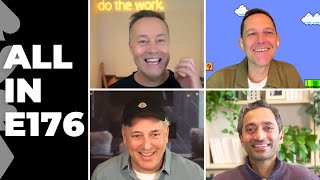
Meta's scorched earth approach to AI, Tesla's future, TikTok bill, FTC bans noncompetes, wealth tax
Episode Details
In this episode, the All-In Podcast provides a deep analysis of several critical topics for entrepreneurs. They begin with Mark Zuckerberg's leadership at Meta and its bold Zuck's Scorched Earth AI Strategy. This strategy involves aggressively promoting Open Source AI by releasing high-performance models like Llama 3 for free, aiming to commoditize the foundational model market and disrupt the business models of closed-source competitors like OpenAI, which is developing GPT-4 and the anticipated GPT-5. This is compared to Google's past success with its open-source Android platform and highlights Meta's inherent advantage in Reinforcement Learning due to its vast user data. The discussion also touches on the AI hardware market, contrasting the needs for Training vs Inference and questioning whether Nvidia is optimized for the latter. The focus then shifts to Tesla, where the hosts praise Elon Musk's consistent execution of his long-term master plan. They debate the future revenue drivers for the company, with strong arguments made for the massive potential of the Optimus (robot) project, the Robotaxi network enabled by FSD (Full Self-Driving), and the disruptive power of Tesla's Energy Business. The competitive landscape for autonomous vehicles is explored, mentioning key players like Waymo, Cruise, Uber, and the Uber-backed Aurora. On the geopolitical and regulatory front, the podcast covers the signing of the TikTok Divest-or-Ban Bill, which forces ByteDance to sell TikTok due to national security concerns regarding the CCP (Chinese Communist Party). The hosts speculate that this sets a precedent that could soon be applied to other foreign-controlled apps like Telegram. They also praise the FTC, under Chair Lina Khan, for its decisive move to ban employee Non-competes, a decision opposed by the US Chamber of Commerce but seen as a pro-innovation policy that has long benefited tech hubs like Silicon Valley. Finally, the episode examines the economic policies of the Joe Biden administration, specifically a proposed Unrealized Gains Tax on high-net-worth individuals, which is politically framed as a solution to fund the long-term solvency of Social Security. The episode is enriched with historical anecdotes about tech giants, recounting interactions with Steve Jobs and discussing the competitive dynamics between Apple, under both Jobs and Tim Cook, and Google, led by figures like Eric Schmidt and Sergey Brin, including stories about the origins of YouTube.
Key Topics & People


.jpg?width=300)


.jpg?width=300)
_(cropped).jpg?width=300)
CEO of Meta who collaborated on the high-level principles of the AI safety accord.

Tesla's humanoid robot, a bold bet made by a strong founder.
.jpg?width=300)
Traditional US tech hub.


.jpg?width=300)
A machine learning technique where models improve through trial and error or reward systems.
.jpg?width=300)
Late CEO of Apple, cited as a gold standard for enforcing strict corporate communication disciplines.
Ruling party of China utilizing social media bots to disrupt US data center expansion.


Co-founder of Google, referenced in discussions about the company's long-term investment vision.
.jpg?width=300)
A major entitlement program adding trillions to the future social liabilities of the US.
Tesla's advanced driver-assistance system that aims to handle dynamic driving tasks.
The movement and development of AI models with publicly accessible source code, such as Llama and Mistral, which are seen as a major competitive threat to closed-source models.
A rapidly growing and highly profitable segment of Tesla's operations, seen as a critical component for supporting the energy needs of future robotics and autonomous vehicle fleets.
A large business-oriented lobbying group in the United States that announced its intention to sue the FTC to block the new rule banning non-compete agreements.
Contract clauses that restrict employees from working for a competitor for a certain period after leaving a company. The FTC has issued a new rule to ban them for the vast majority of workers.
A piece of US legislation, signed into law, that requires ByteDance to sell its US TikTok operations within a year or face a ban in the United States. The law was bundled with foreign aid packages.

Meta's strategy of open-sourcing its powerful AI models, like Llama 3, to commoditize the foundational model market, thereby undermining the business models of closed-source competitors like OpenAI and reinforcing the value of its core advertising business.

Former CEO of Google and a former board member of Apple. His development of Android reportedly made Steve Jobs feel betrayed.
A proposed 25% tax in President Biden's 2025 budget on the total income, including unrealized capital gains, for taxpayers with a net worth over $100 million. It is described as a wealth tax.
The two primary stages of AI computation. Training involves creating the model, while inference is the process of using the trained model to make predictions. The podcast notes that inference is a much larger market where Nvidia may be 'miscast'.