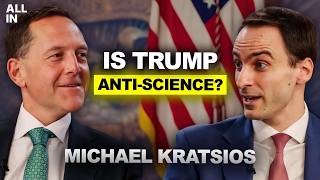
Inside Trump's Science Agenda: Anti-Science Claims, Fauci's Damage, DEI & China w/ Michael Kratsios
Episode Details
The podcast features Michael Kratsios discussing his role at the Office of Science and Technology Policy (OSTP) within the White House. Kratsios outlines the administration's vision for revitalizing Basic Research in the United States, as detailed in the newly released report, Science, a New Golden Age. He emphasizes a return to the foundational Scientific Method, contrasting this approach with the politicization of science seen during the COVID-19 pandemic, which he argues was heavily influenced by figures like Anthony Fauci. The conversation addresses public perceptions, noting a poll that heavily favored Kamala Harris among scientists while marginalizing Donald Trump. A major theme is reforming government agencies that fund science, including the National Science Foundation, the Department of Energy, DARPA, and the NIH. Kratsios criticizes how Congress perpetuates bloated budgets without demanding better outcomes, pointing out the stagnation in drug discovery known as Eroom's Law. He highlights an analysis by Ted Cruz revealing that a large portion of NSF grants were diverted to DEI (Diversity, Equity, and Inclusion) initiatives rather than pure science. Furthermore, Kratsios mentions Chris Wright and his criticism of the "climate emergency" narrative, pointing out that the Intergovernmental Panel on Climate Change (IPCC) recently pulled the extreme RCP 8.5 scenario related to Climate Change. To drive real innovation, the administration is experimenting with Meta-science concepts like Golden tickets, empowering brilliant individuals directly. This mirrors how Venture Capital backed Stewart Butterfield when he founded Slack. The focus is shifting toward monumental goals reminiscent of the Manhattan Project and the Apollo missions, including rapid advancements in Fusion Energy and Quantum Computing. Additionally, the Genesis Mission aims to double scientific output by applying Artificial Intelligence (AI) toward AI for Science. Kratsios reflects on the historical framework set by Vannevar Bush in his seminal report Science, The Endless Frontier, noting that today, Private Sector R&D is a massive driver of innovation, supported by institutions like the Howard Hughes Medical Institute. However, the US is engaged in a fierce technological race against China, particularly in areas like EUV lithography. A critical challenge is the domestic shortage in STEM Fields, exacerbated by flawed Immigration policy and educational missteps, such as the removal of the SAT requirement. Alongside leaders like Russ Vought at the Office of Management and Budget (OMB) and Jay Bhattacharya at the NIH, the administration aims to reward and elevate scientists—celebrating achievements like the Nobel Prize awarded to Demis Hassabis of Google—to ensure American technological supremacy.
The episode discusses the US approach to science and technology policy, emphasizing a return to the scientific method and fostering innovation. Key themes include revitalizing basic research, reforming funding mechanisms, and competing with China. The administration aims to double scientific output by investing in foundational research and emerging technologies like AI, quantum computing, and fusion energy.
Portfolio lens: A basket of ideas focused on the long-term competitiveness of US innovation and scientific leadership against global competitors, with a focus on foundational research and talent.
Generated with gemini-2.5-flash-lite on 8/25/2026, 5:27:45 AM. For research only. Not financial advice.Reinvigorating US Basic Research Funding
Shifting US government R&D funding towards more innovative, scientist-centric models will unlock breakthroughs and double scientific output.
The episode argues that current R&D funding mechanisms are inefficient, leading to stagnation (Eroom's Law). The 'Science, a New Golden Age' report proposes meta-science units, 'golden tickets' for grant reviewers, and flexible grant durations to incentivize risk-taking and novel research.
- The US government spends $200 billion in S&T funding annually, but the question is whether it's driving the best breakthroughs.
- Eroom's Law: drug discovery efficiency has fallen 80-fold since 1950.
- The 'Science, a New Golden Age' report proposes meta-science units and experiments like 'golden tickets' for grant reviewers.
- Testing different grant durations (e.g., 6-month fast-track grants) and empowering individual scientists.
- The goal is to double the scientific output of the United States.
- Implementation of 'golden ticket' and flexible grant duration experiments by NSF and NIH.
- Congressional appropriations aligned with 'Science, a New Golden Age' priorities.
- Demonstrated success in accelerating scientific output through new funding models.
- Resistance from established academic institutions to new funding models.
- Bureaucratic inertia in government agencies hindering implementation.
- Difficulty in measuring the ROI of basic research in the short-to-medium term.
- Political shifts potentially disrupting long-term funding commitments.
- Track the implementation and results of meta-science experiments at NSF and NIH.
- Analyze the impact of 'golden ticket' grants on the types of research funded.
- Monitor Congressional appropriations for basic research funding trends.
- Assess the adoption rate of flexible grant durations.
US Technological Competition with China
The US must aggressively invest in foundational scientific research and talent retention to maintain its technological edge against China's state-directed R&D efforts.
The episode highlights China's rapid increase in R&D spending and scientific publications, posing a threat to US economic and national security. The US needs to address its declining STEM pipeline and retain foreign talent to compete effectively.
- China's R&D spending increased 19x from 2000 to 2021, while US spending increased 3x.
- China is now publishing roughly 50% more scientific papers than the US in many domains.
- China's strategy involves IP theft, creating cheaper alternatives, and market dumping.
- There's a critical shortage in US STEM fields, with foreign-born individuals comprising a majority of US STEM PhDs.
- The US needs to retain foreign talent and encourage more Americans to pursue STEM degrees.
- Increased US government funding for strategic technologies (AI, quantum, fusion, biotech).
- Policy changes to facilitate the retention of foreign STEM graduates in the US.
- Successful initiatives to boost domestic STEM education and participation.
- Technological breakthroughs in key areas like EUV lithography or advanced semiconductors.
- China's continued state-directed R&D investment and industrial policy.
- US immigration policies that hinder the retention of top STEM talent.
- Underinvestment in fundamental research compared to applied AI development.
- Potential for further erosion of US scientific publication output and leadership.
- China's lower labor and supply chain costs providing a competitive advantage.
- Track US government funding allocations for strategic technologies (e.g., CHIPS Act, National Quantum Initiative).
- Monitor changes in US immigration policy related to STEM talent retention.
- Analyze trends in US vs. China scientific publication output and patent filings.
- Assess the effectiveness of US STEM education initiatives.
- Evaluate China's progress in critical technologies like EUV lithography.
Watchlist
- NSF grant application trends (e.g., DEI vs. pure science focus)
- NIH intramural researcher median age
- US vs. China R&D spending growth rates
- Number of US-born vs. foreign-born STEM PhD recipients
- Progress on US fusion energy targets (2035)
- Progress on US quantum computing targets (2028)
- US government announcements on 'golden ticket' or flexible grant experiments
Open Questions
- How will the proposed 'golden ticket' and flexible grant duration experiments be measured for success?
- What specific policy changes are being considered to improve STEM talent retention in the US?
- What is the long-term impact of diverting NSF grants towards DEI initiatives versus fundamental research?
- How will the US government ensure continued investment in fundamental science amidst the focus on AI and applied technologies?
- What are the specific metrics for success in the 'Genesis Mission' to double scientific output using AI?
Key Topics & People
Transformative technology driving market cycles and heavy capital deployment.
Form of private equity and financing provided to startups with high growth potential.

Former US President, cited as an example of a personality-driven political figure with built-in audiences.

A major market for Spotify and Neko Health, noted for its complex and highly expensive healthcare system.


The executive branch of the US government that hosted the Super Intelligence Summit.


_(cropped).jpg?width=300)
Stanford professor involved in discussions regarding COVID-19 research.

Virology expert accused of acting as a blocker regarding COVID-19 origins.
A next-generation power technology listed among the converging advancements altering humanity's trajectory.

Leader of DeepMind prioritizing reliability and alignment in frontier models.
A US department overseeing nuclear and energy projects, which Weinstein hints should engage in deeper theoretical physics discussions.

The WWII atomic bomb project, used as a historical example of highly capable, secretive, and dangerous science.

An independent federal agency supporting science, whose upcoming leadership gives Weinstein hope for reform.
A department in the White House that advises the President on science and technology.

Former White House CTO and OSTP director, praised by Weinstein for his open-minded approach to science reform.
.jpg?width=300)
A new report released by the OSTP detailing strategies to revitalize the American science enterprise.
The empirical method of acquiring knowledge that has characterized the development of science.
An experimental grant allocation method where individual reviewers can unilaterally approve bold research ideas.
The use of scientific methodology to study science itself, intended to increase the quality and efficiency of scientific research.
The observation that drug discovery is becoming slower and more expensive over time, despite improvements in technology.
A seminal 1945 report by Vannevar Bush that guided US government science funding for decades.
A flagship US administration project aiming to double scientific output by applying AI to the hardest scientific challenges.
.jpg?width=300)
Science advisor to FDR who shaped the post-WWII US science enterprise.
Research and development funded and conducted by private companies rather than the government.
Science, technology, engineering, and mathematics disciplines facing a domestic talent shortage in the US.

A non-profit medical research organization mentioned as an alternative funding model for science.
Early-stage, pre-competitive discovery science funded primarily by the federal government.
Director of the Office of Management and Budget involved in drafting the administration's R&D priorities.
.svg?width=300)
The largest office within the Executive Office of the President of the United States.

The global coronavirus pandemic, referenced as a peak moment of anti-science dogma and institutional overreach.

A prestigious international award recognizing academic, cultural, or scientific advances.
Laws regarding foreign nationals coming to the US, particularly debated in retaining foreign STEM PhD graduates.
The application of AI technologies to accelerate basic research and scientific problem-solving.
.jpg?width=300)
.jpg?width=300)
Founder of Slack, cited as an example of backing capable individuals over rigid ideas.
A rapidly-emerging technology that harnesses the laws of quantum mechanics to solve problems too complex for classical computers.

Energy executive referenced as advocating against the characterization of climate change as an immediate emergency.
The United Nations body for assessing the science related to climate change.
Long-term shifts in temperatures and weather patterns, debated in terms of the urgency and emergency narrative.
Frameworks seeking to promote fair treatment and full participation of all people, criticized in the context of scientific grant allocations.

Vice President of the United States, mentioned in relation to a Nature poll on scientists' voting preferences.
