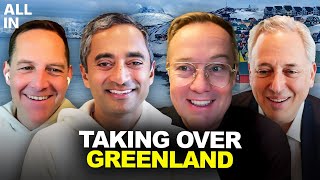
Iran's Breaking Point, Trump's Greenland Acquisition, and Solving Energy Costs
Episode Details
The All-In Podcast hosts, Jason Calacanis, David Sacks, Chamath Palihapitiya, and David Friedberg, kick off by announcing their participation at Davos, where they will host interviews at the USA House, an event also featuring a talk by Donald Trump. The discussion pivots to geopolitics, with David Friedberg analyzing the Anti-regime protests in Iran against Ali Khamenei's regime. This situation is framed as a modern example of Information warfare, with technologies like Starlink countering state censorship, while the crisis is exacerbated by economic Sanctions on Iran from the United States. On the domestic front, the hosts discuss Microsoft's recent decision, influenced by public pressure from Donald Trump, for President Brad Smith to announce that their AI Data Centers will pay for their full energy and grid upgrade costs. This leads to a broader conversation about energy solutions, with Chamath Palihapitiya proposing that hyperscalers fund residential Solar and storage systems. In the AI hardware sector, a major development is OpenAI, led by CEO Sam Altman, striking a $10B deal with Cerebras, a company founded by Andrew Feldman that competes with firms like Grock, for their specialized AI Inference chips. A significant portion of the episode is dedicated to the proposed California Wealth Tax. The hosts, particularly David Sacks, vehemently oppose the measure, labeling it an Asset seizure tax that threatens Private property rights. The initiative is backed by the SEIU union under Dave Rean and presents a major political issue for California Governor Gavin Newsom. Finally, the podcast covers Donald Trump's administration reviving efforts for the Greenland acquisition from Denmark. The strategic importance of the Arctic's melting ice and new shipping lanes is cited as the primary driver for National security, an idea with historical precedent from figures like William Seward and Franklin D. Roosevelt.
Key Topics & People

47th US President who appointed tech leaders to PCAST.

.jpg?width=300)
Podcast host, investor, and organizer of the All-In Liquidity Conference.

Podcast host, scientist, and newly appointed member of PCAST.
Podcast host, investor, and newly appointed co-chair of PCAST.
.jpg?width=300)
Podcast host and tech investor discussing consumer AI trends.

The podcast featuring the interview on longevity, psychedelics, and technology.

The monetization of AI investment via processing inputs and running models.
.svg?width=300)
A region crucial for global supply chains but experiencing significant instability impacting businesses.

The leading nation in AI innovation striving to avoid restrictive regulations that slow technological diffusion.
Infrastructure powering artificial intelligence, which some politicians wish to halt.

Independent US Senator who has proposed a wealth tax and a moratorium on AI data centers.

US state facing government fraud issues and proposing a wealth tax on billionaires.

Governor of California, criticized for his aggressive response to reports of government fraud.
.jpg?width=300)
The Ayatollah and Supreme Leader of Iran.

.jpg?width=300)
CEO of OpenAI, referenced regarding the strategic use of massive capital raises to build competitive moats.
A proposed state-level tax on the ultra-wealthy, projected to cause significant economic deficits.
.svg?width=300)


The exiled Crown Prince of Iran who is leading the transitional plan toward a secular democracy.

Former US President referenced regarding the last time the Supreme Court struck down such sweeping executive policy.
CEO of Cerebras Systems, a company building large, wafer-scale AI chips designed to accelerate AI training and inference.

The practice of placing a data center and its power generation source next to each other, allowing the data center to operate 'behind the meter' and not draw from the public grid. This is the preferred strategy for hyperscalers.

A former US Secretary of State who successfully acquired Alaska and also had ambitions to acquire Greenland.
.jpg?width=300)
The strategic use of information and communication technologies to gain a competitive advantage over an opponent. Discussed in the context of Iran, where Starlink is used to bypass government censorship while the regime uses blocking mechanisms.
The effort by the Trump administration to purchase Greenland from Denmark, framed as a move critical for US national security due to melting Arctic ice and new shipping lanes.

A core legal and philosophical concept discussed in opposition to the California Wealth Tax, with the argument that such a tax would effectively make all private property public property, subject to government seizure by vote.
A term used by the podcast hosts to describe the proposed California Wealth Tax, framing it as the government taking post-tax private property, which they argue is a fundamental shift in property rights.
Economic penalties imposed on Iran, primarily by the United States, which have contributed to severe inflation (averaging 30% since 2019) and economic hardship.

A proposed solution to subsidize residential electricity costs by using tax equity vehicles to pay for homeowners to install solar panels and battery storage systems, making them more self-reliant.

Widespread demonstrations against the ruling Islamic regime in Iran, driven by economic hardship, sanctions, and a desire for modernization among the youth.


The US Secretary of Energy, who has directed changes to make collocation of data centers and power generation easier.

The primary justification for the proposed acquisition of Greenland, citing the opening of new Arctic shipping lanes and Russia's increased presence in the region.
President of Microsoft, who announced the company's new policy to pay for the full cost of its energy and water consumption for new data centers.
.jpg?width=300)