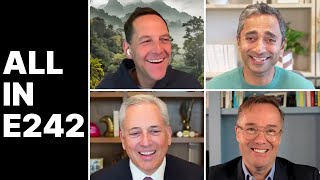
Inside the White House Tech Dinner, Weak Jobs Report, Tariffs Court Challenge, Google Wins Antitrust
Episode Details
The All-In Podcast episode provides an inside look at several critical topics for entrepreneurs and business leaders. The discussion begins with a detailed account of the White House Tech Dinner, a significant event hosted by President Donald Trump to convene the titans of the tech industry. Attendees included Mark Zuckerberg, Tim Cook, Sam Altman, Bill Gates, and Sergey Brin, with co-hosts David Sacks and Chamath Palihapitiya playing key roles. The dinner's purpose was to align on a Pro-innovation Agenda and reinforce America's Technological Supremacy. A related discussion highlighted the work of First Lady Melania Trump in supporting AI education. The conversation then pivots to pressing legal and economic issues. A major segment analyzes the legal challenge to President Donald Trump's Tariffs, which were enacted using Emergency Powers and are now headed for a showdown at the Supreme Court. This raises broader questions about executive authority, a concern also voiced by Senator Rand Paul. On the economic front, the hosts dissect a Weak Jobs Report, expressing deep concerns about the state of the US Economy and the unreliability of data from the Bureau of Labor Statistics (BLS), which complicates policy decisions for the Federal Reserve. The discussion also touches on how tariff revenue funds policies like the Big Beautiful Bill (BBB) and the legal controversy surrounding the deployment of the National Guard. Finally, the episode concludes with an analysis of the Google Antitrust Ruling. The ruling was a win for Google as it avoided a forced breakup, with Judge Meta citing the intense new competition from the AI sector, particularly from companies like OpenAI, as a reason for the more lenient outcome.
Key Topics & People

47th US President who appointed tech leaders to PCAST.
.jpg?width=300)
Podcast host, investor, and organizer of the All-In Liquidity Conference.
Podcast host, investor, and newly appointed co-chair of PCAST.


.jpg?width=300)
CEO of OpenAI, referenced regarding the strategic use of massive capital raises to build competitive moats.

The central bank of the United States, central to a discussion about Donald Trump's nomination of Kevin Warsh as its new chair and the future direction of monetary policy.
.jpg?width=300)

Co-founder of Google, hypothetically referenced regarding decisions to comply with the EU.
.jpg?width=300)
Co-founder of Microsoft, who is mentioned as having one of the most significant and long-lasting relationships with Jeffrey Epstein.
_(cropped).jpg?width=300)
CEO of Meta, described as a 'weather vane' who is more willing to comply with government pressure for censorship compared to Elon Musk.
The overall economic situation in the United States, characterized as fragile and confounding due to conflicting signals like high GDP growth alongside fears of a recession and market weakness.
The highest federal court in the United States, which ruled 5-4 in favor of the federal government's ability to remove razor wire installed by Texas at the border.
The US government agency responsible for economic data like inflation. Bessent addresses and dismisses criticisms from Wall Street that the BLS's positive inflation numbers for October were inaccurate.
A comprehensive social spending and climate bill proposed by the Biden administration, also known as the Build Back Better bill. Joe Manchin's opposition was key to its failure.

A US military reserve force proposed by both Mark Benioff and Donald Trump as a solution to clean up crime and open-air drug markets in San Francisco.

The First Lady, who is chairing the White House's AI education task force and is passionate about ensuring American schoolchildren have access to AI education.
The judge who presided over the Google antitrust case and rejected the harshest penalties (like spinning off Chrome), citing the changed competitive landscape due to AI.
The Trump administration's policy stance focused on supporting innovation, infrastructure, energy, and exports to help tech companies and the broader economy grow. This was a key reason cited for the tech leaders' support at the dinner.
An economic report for August showing lower-than-expected job growth, a rise in part-time over full-time jobs, and significant downward revisions to previous months' data. It sparked debate about the state of the US economy and the reliability of government data.
A dinner hosted by President Trump at the White House for top technology leaders to discuss the tech industry, the economy, and pro-innovation policies. The event aimed to foster alignment and cooperation between the administration and Silicon Valley.
The concept that America's economic and military dominance is derived from its leadership in technology. This was a core theme of the White House Tech Dinner, with the President positioned as an advocate for the tech leaders who create this supremacy.
A legal decision where Google was found liable for antitrust violations but avoided harsh penalties like a forced breakup. The judge cited the significant market competition from AI as a key factor.

The authority granted to the President to take unilateral action during a national emergency. Its use for implementing tariffs is the subject of a major legal and political debate.