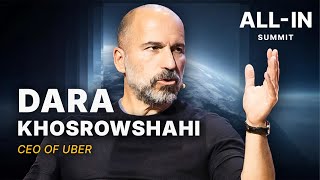
Uber CEO Dara Khosrowshahi on self-driving's future, changing business model, job displacement
Episode Details
In a detailed discussion, Uber CEO Dara Khosrowshahi elaborated on the company's multifaceted strategy for navigating the future of transportation, with Autonomous Driving at its core. He emphasized that Uber's strength lies in its Network Effects, positioning it as an ideal platform to support the entire AV Ecosystem by maximizing vehicle utilization for partners. This is demonstrated through existing partnerships with leaders like Waymo in Atlanta and Austin, and numerous emerging players in China, a market rapidly advancing in Level 4 Autonomy. Khosrowshahi contrasted Waymo's sensor-rich approach using LiDAR and HD Maps with Tesla's Computer Vision-only strategy, extending an open invitation to Elon Musk to bring Tesla Robotaxis onto Uber's network to boost revenue for their owners, which Musk envisions as 'Digital Shepherds'. Uber's business model will transition to a Hybrid Network of human drivers and autonomous cars, largely maintaining its Asset-light business model long-term, despite a willingness to use its balance sheet to accelerate adoption. This financial strength is evidenced by a $20 billion Stock Buyback. Beyond ground transport, Uber is investing in the third dimension of urban mobility with EVTOL technology through its stake in Joby, and is innovating in its Uber Eats division with Sidewalk Robots and Drone Delivery. Khosrowshahi also noted a continuing working relationship with ventures from founder Travis Kalanick, such as Cloud Kitchens, and candidly addressed the long-term societal challenge of Job Displacement for drivers, acknowledging it as a significant issue that will need to be confronted.
Key Topics & People

.jpg?width=300)
Co-founder and former CEO of Uber.
.jpg?width=300)


The application of AI to create self-driving vehicles that can reason about their environments.


The transition process where specific jobs are automated by AI, even if overall employment grows.
The initial food-focused business unit of Atoms, operating globally under various localized names.
.jpg?width=300)
The CEO of Uber, noted as an incredibly successful business leader from the Iranian diaspora.
A phenomenon where a product gains value as more users join. The podcast debates whether Carta truly benefits from strong network effects, with Chamath arguing it does not.
A field of AI that enables computers to interpret and understand visual information from the world. It is used in defense applications, such as in Allen Control Systems' product to identify and target enemy drones.
An autonomous logistics system that uses unmanned aircraft to transport goods. Zipline is a global leader in this technology.
The entire industry surrounding autonomous vehicles, including software providers, vehicle owners, and fleet operators, which Uber aims to support as a platform.
Tesla's planned autonomous vehicle network, which Uber hopes to partner with to provide demand and maximize asset utilization.
A term associated with Elon Musk's vision, describing the individual owners of Tesla robotaxis who would manage their vehicles on the network.
A standard of autonomous driving where a vehicle can operate without a human driver under specific conditions. This is already being deployed by some companies in China.

Small, slow-moving autonomous vehicles designed for short-distance deliveries on sidewalks, which Uber is integrating into its delivery platform.
A capital allocation strategy where a company repurchases its own shares. Uber announced a $20 billion plan, indicating strong cash flow.
.jpg?width=300)
Uber's traditional model of not owning the vehicles on its platform, which may evolve as the company considers taking on balance sheet risk to prove out AV business models.
Uber's strategy to operate a network of both human drivers and autonomous vehicles simultaneously for the foreseeable future.