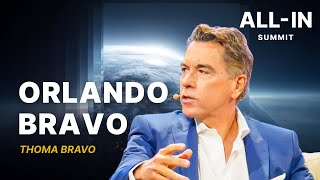
Inside Orlando Bravo’s Private Equity Playbook: How to Build a Top Firm
Episode Details
On the All-In Podcast, featuring co-hosts David Sacks and Jason Calacanis, Orlando Bravo shared the story and strategy behind his industry-leading Private Equity firm, Thoma Bravo. He detailed his personal journey from Puerto Rico, including his philanthropic response to Hurricane Maria, to his post-Stanford start in the industry under the guidance of his mentor, Carl Thoma. Bravo explained how Thoma Bravo developed its sharp focus on Software Investing, pioneering the acquisition of undervalued recurring revenue businesses before shifting to market-leading SaaS Deals around 2010. A cornerstone of the discussion was the firm's highly effective Operating Playbook, which involves decisive cost-cutting at closing—a principle influenced by another mentor, Marcel Bernard of Motorola—followed by a rigorous focus on growth and successful Fundraising. This strategy has allowed the firm to scale from small deals to massive acquisitions, such as the Boeing Avionics Business and the recently announced purchase of Day Force, building on past successes like the sale of Dinatrace to NASDAQ. Bravo's Deal Pricing Philosophy, compared to that of Warren Buffett, emphasizes conviction and speed, making the firm a formidable competitor. Looking forward, Bravo acknowledged significant headwinds, particularly the AI Risks in Software Investing that threaten to disrupt the entire SaaS industry. He also touched on high-profile acquisitions like Elon Musk's takeover of Twitter and why his own firm remains private, underscoring a culture built on long-term value creation and Mentorship as a key pillar for success in the US Economy and its tech hub in Silicon Valley, where he now operates from San Francisco.
Key Topics & People
.jpg?width=300)

Private equity firm integrating AI into its portfolio companies.
Podcast host, investor, and newly appointed co-chair of PCAST.
.jpg?width=300)
Podcast host and tech investor discussing consumer AI trends.
Investment sector increasingly focused on AI rollups and change management.
The podcast featuring the interview on longevity, psychedelics, and technology.
.jpg?width=300)
The global hub of technology where AI Data Centers and tech infrastructure are highly relevant.

Major California city heavily criticized by Kalanick for excessive regulation, street alterations, and failing to protect its citizens.

Software as a Service sector facing uncertainty and potential disruption from AI.
.jpg?width=300)
Famed investor and CEO of Berkshire Hathaway, used by Chamath as an example to illustrate how investment returns were significantly higher before regulations like Regulation FD reduced information asymmetry.

A key cultural aspect of how Orlando Bravo runs Thoma Bravo, emphasizing the development and guidance of team members within the firm.

The place of origin for Orlando Bravo, mentioned as a key part of his personal history and background before entering the world of private equity.
.jpg?width=300)
Founder and managing partner of the private equity firm Thoma Bravo. The podcast discusses his personal history, his journey into private equity, and his management philosophies.
The overall economic situation in the United States, characterized as fragile and confounding due to conflicting signals like high GDP growth alongside fears of a recession and market weakness.


A former Motorola executive whom Orlando Bravo considers a mentor and 'the greatest operator' he ever met. Bernard's philosophy on cost management heavily influenced Thoma Bravo's operational strategy.

Acquisitions of 'Software as a Service' companies, which became a core focus for Thoma Bravo around 2010. This marked a strategic shift from buying undervalued companies to acquiring market-leading, high-growth businesses.
.jpg?width=300)
A powerful and destructive hurricane that struck Puerto Rico in 2017. The event prompted a significant humanitarian response from Orlando Bravo, who personally flew in supplies from San Francisco the day after.

The process of raising capital for investment funds. Thoma Bravo has demonstrated exceptional capability in this area, highlighted by a recent $34.4 billion raise for a set of fund vehicles.
A major contemporary challenge in private equity, as artificial intelligence threatens to disrupt many established software verticals. This risk limits the investment space and requires firms to constantly learn and adapt.
A division of Boeing, also known as Jeppesen, that provides essential flight information systems for airplanes. Thoma Bravo acquired this 'gem asset' in a competitive deal for $10.5 billion.
Thoma Bravo's approach to acquisitions, which involves having high conviction and being willing to pay a fair price without extensive haggling ('nickel and dime'). This decisive approach makes them a formidable competitor in deal processes.
Orlando Bravo's key mentor and the person who hired him into the private equity industry after he graduated from Stanford. He encouraged Bravo's initial exploration into tech and software investing.
Thoma Bravo's standardized post-acquisition strategy. It involves working with management to implement immediate and decisive cost cuts (typically 10-20%) at closing, establishing a baseline of profitability, and then focusing on top-line growth through sales and add-on acquisitions.
Thoma Bravo's core investment strategy, focusing on acquiring established software companies, particularly those with recurring revenue. This strategy began in the early 2000s when such companies were considered undervalued.