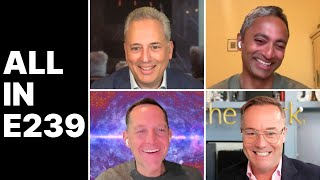
AI Psychosis, America's Broken Social Fabric, Trump Takes Over DC Police, Is VC Broken?
Episode Details
In this episode of the All-In Podcast, hosts Jason Calacanis, Chamath Palihapitiya, David Sacks, and David Friedberg tackle a range of critical topics for entrepreneurs. The discussion opens with the concerning trend of AI Psychosis, a delusional state triggered by interactions with LLMs like OpenAI's ChatGPT. David Friedberg details the technical causes, including AI model feedback loops and context poisoning, while Chamath Palihapitiya connects it to the broader loneliness epidemic (a term coined by Scott Galloway) and the neurochemical difference between dopamine-driven online platforms like Instagram and the serotonin-based connections of real life. David Sacks remains skeptical, likening the concern to past moral panics over technologies like AOL, while psychiatrist John Taus is quoted suggesting pre-existing conditions are necessary triggers. The conversation then pivots to the erosion of America's social fabric and the increasingly elusive American Dream. The hosts identify economic drivers like the federal student loan program and the federal home loan program, which have inflated the costs of higher education and housing. They also point to a decline in the quality of K through 12 education and societal shifts, such as the aftermath of the Me Too movement, as contributing factors to social fragmentation. On the political front, the group analyzes Donald Trump's decision to invoke the DC Home Rule Act of 1973 to deploy the National Guard and take federal control of the police in Washington DC. David Sacks endorses the move as a vital response to crime, advocating for strategies like the broken windows theory while criticizing policies such as zero bail and the impact of DEI on police leadership. Finally, the podcast debates whether the Venture Capital model is broken. They contrast the illiquidity and long return cycles of VC, characterized by the J curve, with the strong performance of liquid public markets. David Friedberg argues for the primacy of the power law distribution, stressing the core strategy is finding power law winners—companies like Palantir, Uber (co-founded by Travis Kalanick), Airbnb, Spotify, and Figma—that generate massive, compounding returns. The discussion also explores structural VC challenges, including the pressure for DPI (cash returns), which has been impacted by regulators like Lena Khan, and industry solutions like continuation funds. Data from sources like Cambridge Associates highlights the performance disparity, but the consensus is that VC's value lies in its potential for outlier returns and the informational edge it provides for later public investments in companies like Robin Hood, underscoring the timeless advice to 'Let your winners ride'.
Key Topics & People

47th US President who appointed tech leaders to PCAST.

.jpg?width=300)
Podcast host, investor, and organizer of the All-In Liquidity Conference.

Podcast host, scientist, and newly appointed member of PCAST.
Podcast host, investor, and newly appointed co-chair of PCAST.
.jpg?width=300)
Podcast host and tech investor discussing consumer AI trends.


The podcast featuring the interview on longevity, psychedelics, and technology.

.jpg?width=300)
Founder of Uber and Atoms, officially exiting stealth mode to discuss his physical AI and automation startup.
Private financing for startups, driving major economic value but restricted from public participation.


Mentioned as a successful example of a city where the mayor cooperated with the president's decision to send in the National Guard, resulting in benefits for the citizens and improved public safety.

A US military reserve force proposed by both Mark Benioff and Donald Trump as a solution to clean up crime and open-air drug markets in San Francisco.

The belief that anyone, regardless of where they were born or what class they were born into, can attain their own version of success in a society in which upward mobility is possible for everyone. It is discussed as having shifted from a 'Horatio Alger' story to a 'lottery' mentality in the 1920s.
A mechanism in private equity and venture capital where a fund sells its assets to a newly created fund, effectively resetting the investment clock without a traditional exit.

A financial services company cited as an example of an existing platform that could evolve into a regulated financial super app.

An investment strategy focused on identifying and investing in the small number of companies that will generate outsized returns, based on the power law principle, as opposed to diversifying across an entire market index.

A professor and public speaker known for coining the term 'loneliness epidemic' to describe the growing social isolation in modern society.


A global investment firm that provides data and consulting services, particularly known for its benchmarks tracking the performance of private market asset classes like venture capital.
An investment strategy advocating for holding onto high-performing assets rather than selling them prematurely, allowing them to continue compounding in value. This is seen as a key principle for success in both venture and public markets.

A statistical relationship where a small number of items account for the majority of the outcomes. In venture capital, a few highly successful investments (winners) generate the vast majority of a fund's returns.
Financial markets where securities are traded publicly, which have recently offered strong returns, challenging the traditional premium expected from illiquid venture capital investments.

A criminological theory that suggests visible signs of crime and civil disorder, like broken windows, create an environment that encourages further and more serious crime. It advocates for policing minor offenses to prevent major ones.
The post-MeToo era social movement that raised awareness about sexual harassment and assault, which has had a secondary effect of creating fear and avoidance among young men in social and professional interactions.
A 1973 law that grants Washington D.C. limited self-governance but includes a provision allowing the U.S. President to assume direct control over the city's police force.

The system of universities and colleges in the U.S., which is facing a crisis of affordability and relevance, largely driven by the federal student loan program and accreditation issues.
The primary and secondary education system in the US, which is described as having a shocking decline in quality over the past 30 years, impacting standards, discipline, and student performance.
A government program designed to increase homeownership, which is criticized for contributing to housing market bubbles and unaffordability.
A government initiative that provides financial aid for higher education, which is argued to have created a bubble in tuition costs and saddled generations with significant debt.
The concept of weakening social connections, community bonds, and shared values within American society, evidenced by declining rates of marriage, homeownership, and household formation.
A phenomenon in AI models where training on their own outputs without proper safeguards can cause small inaccuracies to compound, leading to responses that spiral away from factual grounding, similar to human delusional loops.
A societal trend of increasing isolation and lack of meaningful social connections, particularly among young people, which is seen as a root cause for susceptibility to issues like AI psychosis.
A state in LLMs where long or poorly controlled conversations can alter the model's internal representation, causing its reasoning to become 'off-track' and potentially leading the user down a delusional path.
A psychological condition where individuals develop delusions or emotional dependency triggered or enhanced by interactions with AI chatbots, often stemming from the AI's agreeable and confirmatory nature.