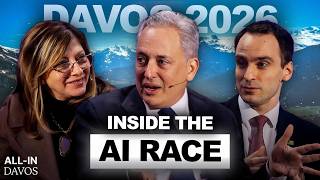
Inside America’s AI Strategy: Infrastructure, Regulation, and Global Competition
Episode Details
In a discussion moderated by Maria Bartiromo, David Sacks and Michael Kratsios analyze America's strategy in the global AI Race, primarily against China. David Sacks expresses confidence in the United States's position, citing the innovation from American Companies in Silicon Valley, which operates on a principle of Permissionless Innovation. However, both speakers highlight significant challenges, including the massive AI Infrastructure Buildout required for Data Centers and the associated Energy Challenges, which has turned the AI Race into a 'power race'. A key domestic issue is AI Regulation, with a debate between a chaotic Patchwork of state regulations and a proposed lightweight Federal AI Regulation. President Trump's administration is credited with setting a pro-innovation AI Action Plan and pushing back against what David Sacks calls Woke AI—politically biased models influenced by DEI principles, as seen in the rescinded Biden Executive Order on AI and exemplified by Google's Gemini controversy. The global US vs China AI Competition is fierce across the stack, from Chips (where the US leads) to AI Models. China holds advantages in energy production and public AI Optimism, and is promoting national champions like Huawei while blocking competitors like Nvidia. The US response includes the American AI Export Program to increase global Market Share of its technology. Michael Kratsios emphasizes the transformative potential of AI for Science to accelerate discovery. The conversation also touches on the societal impact of AI, referencing Elon Musk's predictions about future Abundance and Job Displacement, and contrasting the US innovation model with Europe's more restrictive, Precautionary Principle-based approach.
Key Topics & People

Director of OSTP and co-chair of PCAST alongside David Sacks.
.jpg?width=300)


Podcast host, investor, and newly appointed co-chair of PCAST.
Facilities housing vast amounts of compute and GPUs.
The transformation and occasional elimination of traditional jobs due to the rise of AI agents and autonomous systems.


The leading nation in AI innovation striving to avoid restrictive regulations that slow technological diffusion.
Legislative efforts to control AI, which are challenged by the rapid pace of technological paradigm shifts.

.jpg?width=300)
The global hub of technology where AI Data Centers and tech infrastructure are highly relevant.

Independent US Senator who has proposed a wealth tax and a moratorium on AI data centers.
The massive, ongoing investment phase in hardware, data centers, and power required to support generative AI globally.
US State that implemented a new millionaire tax, causing prominent business leaders to leave.
The primary breakout use case for AI in enterprise software engineering.
Advanced technology contributing to job automation and global competition.
US President who delivered a State of the Union address emphasizing the Rate Payer Protection Pledge and implementing sweeping tariffs.
A regulatory mindset, attributed to Europe, where policymakers focus on hypothesizing everything that could go wrong with a new technology and designing rules to prevent those outcomes, often stifling innovation.
A key area of AI application discussed by Michael Kratsios, with the potential to dramatically accelerate scientific discovery in fields like fusion, material science, and healthcare by overcoming data fragmentation.
_(cropped).jpg?width=300)
The moderator of the discussion on America's AI strategy.
The US department responsible for gathering industry input and issuing proposals for the American AI Export Program.
A regulatory action from the previous administration that was rescinded by President Trump. It was criticized for promoting DEI in AI models and creating a burdensome regulatory environment.
A measure of the public's belief that AI will be more beneficial than harmful. Polling shows much higher AI optimism in China (83%) compared to the US (39%), which could impact regulatory approaches.
Considered the key metric for winning the AI race. The goal is for American chips and models to have dominant global market share in the future.
The strategic rivalry between the two nations across the entire AI stack, from semiconductor equipment and chips to frontier models and global technology adoption.
The current situation in the US where numerous states are creating their own individual AI laws, which is seen as detrimental to innovation and particularly burdensome for startups.
A core concept of Silicon Valley's success, where entrepreneurs can develop and launch new technologies without needing prior government approval. This is contrasted with a more regulated approach.
An evolved form of AI tools, moving beyond coding assistants to help knowledge workers with a wide range of tasks by integrating with their files, emails, and data, potentially with a voice interface.
The significant issue of providing enough electrical power for the energy-intensive data centers, which has become a critical bottleneck in the AI race.
The US Secretary of Energy who has been working to reform regulations to make it easier for AI data centers to generate their own power 'behind the meter'.
The primary drivers of AI innovation in the United States, developing cutting-edge models, chips, and products.
A US government initiative aimed at ensuring American AI technology (models, chips, applications) is adopted globally by partners and allies to counter Chinese influence.
Large cloud computing companies that are major players in the AI infrastructure buildout. They plan to build their own power generation rather than just drawing from the public grid.
A US federal department whose national labs hold vast amounts of scientific data that could be used to train AI models for scientific discovery.
The national governing body of the United States, whose role in AI is debated, particularly concerning regulation and innovation support.
The Trump administration's pro-innovation, pro-infrastructure, pro-energy, and pro-export strategy for artificial intelligence.
.svg?width=300)

The proposed solution to the patchwork of state laws, advocating for a single, lightweight national framework to govern AI, promoting consistency and innovation.