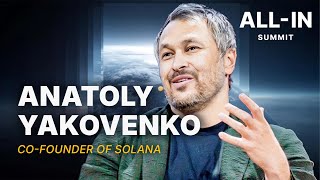
Solana’s Anatoly Yakovenko on Crypto's Next Era: Quantum, AI, and the Future of Money
Episode Details
In a comprehensive discussion on the future of crypto, Anatoly Yakovenko, CEO of Solana Labs and co-founder of Solana, outlines the industry's evolving landscape. He highlights a dramatic improvement in the US regulatory environment, crediting figures like David Sacks for a positive shift away from what he describes as the hostile regime of Gary Gensler. Yakovenko is optimistic about legislation like the Genius Act, predicting it will unlock trillions in Stablecoins, which will in turn drive massive demand for US Treasuries and help export American Finance globally. He strategically differentiates Solana as the 'World's Execution Layer' focused on speed, from its competitor Ethereum, founded by Vitalik Buterin, which he defines as the 'World's Settlement Layer. ' Institutional interest is growing, as shown by BlackRock building on Solana and traditional players like Nasdaq exploring Tokenization of Securities. Looking ahead, Yakovenko sees immense potential in verticals like the Creator Economy on Blockchain, which requires the legal framework of the CLARITY Act to flourish, and in bringing Real World Assets on Blockchain to enhance risk management in DeFi. He also addresses significant technological challenges, warning that a breakthrough in Quantum Computing, potentially accelerated by AI, threatens current Cryptography. This necessitates a proactive migration of platforms like Bitcoin to Quantum-Resistant Cryptography, a move that would likely follow adoption by tech giants Google and Apple. While praising Bitcoin for its elegant Proof of Work design, he notes the risk of Centralization of Bitcoin from large holders like MicroStrategy. Finally, Yakovenko posits that payment giants Visa and Mastercard are well-positioned as tech companies to use stablecoins, leading to a major Disruption of Traditional Banks.
Key Topics & People
Podcast host, investor, and newly appointed co-chair of PCAST.


An emerging technology that potentially poses a security risk to cryptographic systems like Bitcoin.
.jpg?width=300)
Crypto founder who donated large sums to AI doomer organizations.
Proposed legislation designed to bring definitive regulatory structure to crypto assets.

Former SEC Chair criticized for an aggressive regulation-by-enforcement approach toward crypto.
US government debt instruments that are seeing reduced demand from foreign buyers.

A piece of legislation that provides regulatory clarity for stablecoins in the United States, defining them as a payment instrument and setting rules for issuers like Circle.
A type of cryptocurrency whose value is pegged to another asset class, like a fiat currency or gold, to maintain a stable price. Discussed as a key infrastructure layer for money on the internet.

The concept of using crypto tokens to fund creators, create new IP, and allow fans to have a financial stake in a creator's success, moving away from ad-based monetization models.
The company led by CEO Anatoly Yakovenko that is a core contributor to the Solana blockchain ecosystem and drives its innovation.
The potential for technology companies like Visa and Mastercard to use stablecoins to remove issuer and receiver banks from the transaction loop, capturing their higher profit margins.
The consensus mechanism used by Bitcoin, described as a 'masterpiece' of elegance and simplicity that makes the network very robust against attacks.

Co-founder of Solana and CEO of Solana Labs, who is driving innovation in Web3 and provides the core vision for Solana as the 'world's execution layer'.
A potential risk to Bitcoin's decentralized ethos, where large entities like MicroStrategy acquire a significant percentage of the total supply.
The movement to bring assets like real estate, bonds, and insurance onto the blockchain to serve as non-correlated assets for hedging and risk management in DeFi.
The role Anatoly Yakovenko ascribes to Ethereum, where the finality and security of transactions are prioritized over speed, suitable for settlement which can take minutes.

Cryptographic algorithms that are secure against an attack by a quantum computer. Yakovenko suggests that platforms like Bitcoin should migrate to such schemes proactively.
The process of converting rights to an asset, such as stocks or bonds, into a digital token on a blockchain. This is being explored by traditional exchanges like Nasdaq.
The financial system of the United States, which Anatoly Yakovenko believes can be exported globally through crypto technology, providing a significant benefit to America.
Anatoly Yakovenko's strategic positioning for Solana, emphasizing high-speed, low-latency transaction processing for global markets, akin to a global financial computer.

The underlying security technology for cryptocurrencies. Yakovenko highlights the future threat posed to current cryptographic standards by the advent of quantum computing.

A major payment processing company, viewed more as a technology company than a financial one. Yakovenko suggests they could leverage stablecoins to disrupt the banking sector.

A company that has acquired a large percentage of Bitcoin's supply, raising concerns about the centralization of the asset.