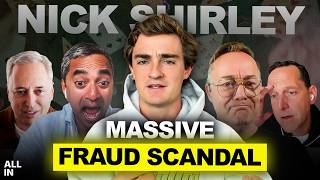
Massive Somali Fraud in Minnesota with Nick Shirley, California Asset Seizure, $20B Groq-Nvidia Deal
Episode Details
The All-In Podcast features an extensive interview with 23-year-old investigative journalist Nick Shirley, who discusses his viral YouTube report on the massive Minnesota Daycare Fraud. This multi-billion dollar Entitlement Fraud involves exploiting the CCAP (Minnesota Child Care Assistance Program) and is linked heavily to the Somali community in Minnesota. The conversation explores the possibility that this is not just isolated crime, but part of a systemic Patronage System involving Political Corruption, where politicians like Minnesota Governor Tim Walz and the Minnesota State Government allegedly turn a blind eye in exchange for votes. The most explosive allegation is the potential for Terrorism Funding, with funds possibly being funneled to the terrorist group al-Shabaab. The discussion then broadens to a critique of widespread Government Waste in the US, citing California as another major example with its Homeless Industrial Complex. This leads to an analysis of the proposed California Billionaire Tax Act, which the hosts condemn as a form of Asset Seizure that threatens Private Property Rights. They argue that such populist measures gain traction due to failures like the lack of Universal Healthcare. The hosts believe these revelations vindicate figures like Elon Musk, who have long warned of such fraud, and predict that the Bond Market will eventually force a reckoning upon fiscally irresponsible states like California. In the final segment, Chamath Palihapitiya celebrates a victory lap for the $20 billion Groq-Nvidia Deal, a landmark event for AI Infrastructure. He details his successful Non-consensus Investing in Groq, a company founded by Jonathan Ross (inventor of the TPU at Google) that specializes in Inference Chips for the Decode (AI) phase of processing. The deal with Nvidia, led by CEO Jensen Huang and dominant in GPUs for the Prefill (AI) phase, is presented as a strategic move to make AI technology cheaper and more accessible.
Key Topics & People

.jpg?width=300)
.jpg?width=300)
CEO of Nvidia, noted for calling out the AI inflection point.

.jpg?width=300)
Podcast host, investor, and organizer of the All-In Liquidity Conference.

Podcast host, scientist, and newly appointed member of PCAST.
Podcast host, investor, and newly appointed co-chair of PCAST.
.jpg?width=300)
Podcast host and tech investor discussing consumer AI trends.

The podcast featuring the interview on longevity, psychedelics, and technology.
Massive compute systems built to support AI model training and inference.


US state facing government fraud issues and proposing a wealth tax on billionaires.
A journalist who investigates and reports on government fraud.

A specific incident of large-scale fraud involving public dollars allocated to non-existent daycares.
The practice of individuals independently researching and reporting on major stories, exemplified by guest Kevin Bass's use of AI to analyze the Epstein files and publish his findings on social media.

The federal governing body of the United States, whose various departments (Commerce, Treasury, etc.) are instrumental in executing the economic policies discussed.

Founder and CEO of Groq and the founder of Google's TPU. Chamath interviewed him about the AI landscape and AI acceleration.
The governing body of California, discussed in the context of massive government waste, fiscal mismanagement, and the proposal of a controversial wealth tax.
The governing body of Minnesota, criticized for its lack of oversight and potential complicity in the massive entitlement fraud happening within the state.
A healthcare system providing access to all citizens. The podcast posits that the lack of universal healthcare in the US fuels resentment and creates political support for wealth-confiscating policies like the billionaire tax.
A potential outcome for fiscally mismanaged states like California. The podcast discusses whether states should be allowed to declare bankruptcy to restructure their massive debts and obligations.
President of Groq, who is credited with bringing a practical, go-to-market focus that complemented Jonathan Ross's technical vision.
The market for government and corporate debt. The podcast predicts that the bond market will eventually react negatively to the massive fraud and fiscal irresponsibility in states like California, forcing a financial reckoning.
A local news station in Minnesota where reporter Jeff Balon initially exposed the daycare fraud schemes over a decade ago.
A local investigative reporter at Fox 9 News who first began investigating the Somali daycare fraud in Minnesota back in 2013.
The 'writing' phase in an LLM's process, where the model generates a response one token at a time. This phase is memory-bandwidth constrained and is Groq's architectural strength.
An investment strategy that involves making bets that are contrary to prevailing market beliefs. Chamath Palihapitiya's long-term investment in Groq is cited as a successful example.
The 'reading' phase in an LLM's process, where the model processes the user's entire prompt at once. This phase is compute-bound and is a strength of Nvidia's GPUs.
A $20 billion licensing agreement where Nvidia will use Groq's technology for AI inference chips. This deal is presented as a major strategic move in the AI hardware space.
A proposed ballot measure in California that would levy a 5% tax on the assets of residents with a net worth over a billion dollars. It is framed as a form of private property seizure.
A fundamental principle discussed in the context of the proposed California wealth tax, which is seen as a direct threat to the right of individuals to own property without arbitrary government seizure.
The act of the government taking private property. The California Billionaire Tax Act is discussed as a form of asset seizure, setting a dangerous precedent for government overreach.
The inefficient and fraudulent spending of taxpayer money by government bodies. The conversation uses examples from both Minnesota and California to argue this is a widespread national crisis.
A term used to describe the network of organizations and programs in California that receive billions in funding to address homelessness, yet the problem continues to worsen, implying massive fraud and inefficiency.
The allegation that the money stolen through the entitlement fraud in Minnesota is being used to finance international terrorist groups like al-Shabaab.
A terrorist group based in Somalia. The podcast discusses allegations and evidence that money from the Minnesota fraud schemes is being funneled to this organization.
The theory that the fraud is not just isolated misconduct but a system where politicians allow the flow of government funds to specific communities in exchange for votes and political power.
A central theme of the discussion, suggesting that government officials may be complicit in or willfully ignoring fraud in exchange for political support and votes.
A state-administered, federally-funded program in Minnesota designed to subsidize childcare for low-income families. It is the primary vehicle through which the daycare fraud was allegedly committed.
The overarching issue of illegally obtaining money from government welfare and subsidy programs. The podcast discusses this as a systemic problem in the U.S., with the Minnesota case being a prime example.
A significant immigrant community in Minnesota, members of which have been disproportionately charged in connection with the state's massive entitlement fraud schemes.
A type of AI processor specialized for the 'decode' or 'writing' phase of an AI model's operation (generating a response), which is Groq's area of expertise.