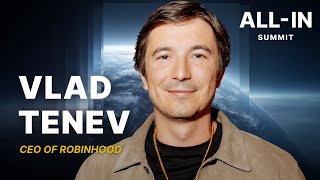
Robinhood CEO Vlad Tenev on tokenizing stocks, expanding access to private shares, fintech's future
Episode Details
In a detailed discussion, Vlad Tenev, the CEO and founder of Robinhood, outlined the company's vision and recent strategic moves, notably its inclusion in the S&P 500. The core of the conversation centered on the innovative strategy of Tokenizing Securities, where Robinhood uses Blockchain technology to offer fractional ownership of private companies like OpenAI and SpaceX. This initiative was first launched in Europe with the goal of eventually bringing it to the US to provide retail investors with Access to Private Company Shares. This move prompted conversations with OpenAI's CEO, Sam Altman, and highlights the regulatory complexities involved. Tenev described a markedly improved relationship with the current White House administration compared to the last, seeing it as more open to innovation, though he still faces staunch opposition from critics like Senator Elizabeth Warren over concerns of Consumer Protection in Fintech. To achieve his vision in the US, Tenev advocates for a Relaxation of Accreditation Standards, pointing to the Genius Act for Stablecoins as a positive regulatory precedent from the US Government. The discussion also explored the broader market trend of Fintech Convergence, positioning Robinhood's ambition to become a Comprehensive Financial Platform as a direct challenge to fintech peers like Coinbase and Stripe, and financial incumbents like JP Morgan, Visa, and Mastercard. The podcast also featured a story from early investor Jason Calacanis about funding Robinhood's seed round after a pitch from Tenev, which occurred while Elon Musk was present. Separate from his work at Robinhood, Tenev also discussed his other company, Harmonic, and its ambitious goal to create Mathematical Superintelligence.
Key Topics & People

.jpg?width=300)
.jpg?width=300)
Podcast host and tech investor discussing consumer AI trends.


.jpg?width=300)
CEO of OpenAI, referenced regarding the strategic use of massive capital raises to build competitive moats.


US Senator who stood in bipartisan support of banning congressional insider trading.
A piece of legislation that provides regulatory clarity for stablecoins in the United States, defining them as a payment instrument and setting rules for issuers like Circle.
A type of cryptocurrency whose value is pegged to another asset class, like a fiat currency or gold, to maintain a stable price. Discussed as a key infrastructure layer for money on the internet.
.svg?width=300)

A distributed ledger technology. The Department of Commerce under Lutnick began publishing official GDP data on the blockchain for transparency and modernization.
The federal governing body of the United States, whose various departments (Commerce, Treasury, etc.) are instrumental in executing the economic policies discussed.

The executive branch of the U.S. government where David Sacks serves as a special government employee, advising on AI and crypto policy.

A major payment processing company, viewed more as a technology company than a financial one. Yakovenko suggests they could leverage stablecoins to disrupt the banking sector.
A proposed policy change that would lower the barrier for retail investors to participate in private markets, moving away from strict income/wealth requirements towards models like self-certification of risk understanding.
Robinhood's long-term business strategy to become the primary financial institution for its users, integrating services like direct deposit, spending, investing, and retirement into a single application.
The regulatory argument that expanding retail access to sophisticated financial products could harm consumers, which is the stated motivation for critics like Elizabeth Warren who advocate for more restrictive policies.
A key strategic objective for Robinhood, aiming to enable retail investors to invest in high-growth private companies, a market traditionally reserved for accredited investors. Tokenization is seen as the key enabling technology for this.
An advanced form of AI focused on mathematical reasoning that surpasses the capabilities of any human researcher. This is the primary goal of Vlad Tenev's company, Harmonic.
A market trend where previously distinct financial services (brokerage, payments, banking, credit) are being integrated into single platforms. Companies like Robinhood, Coinbase, and Stripe are all expanding their services, leading to increased competition.

_(2)_(cropped).jpg?width=300)
CEO and co-founder of Robinhood, a financial technology company. He is also the founder of Harmonic, a company focused on developing mathematical superintelligence.
A strategic innovation by Robinhood involving the representation of ownership in assets, such as public and private stocks, as digital tokens on a blockchain. This is intended to increase liquidity, enable 24/7 trading, and make illiquid assets accessible to a broader audience.