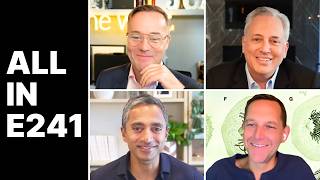
Trump Takes On the Fed, US-Intel Deal, Why Bankruptcies Are Up, OpenAI's Longevity Breakthrough
Episode Details
This episode of the All-In Podcast delves into several major themes at the intersection of politics, economics, and technology. The discussion, led by hosts Jason Calacanis, Chamath Palihapitiya, David Sacks, and David Friedberg, begins with the escalating conflict between Donald Trump and the Federal Reserve (Fed). This is highlighted by the unprecedented firing of Fed Governor Lisa Cook, a nominee of Joe Biden, which has led to a legal challenge expected to reach the Supreme Court and a criminal referral to the DOJ (Department of Justice). The hosts debate the core issue of Fed Independence, with Sacks arguing that Chair Jerome Powell's decisions on Monetary Policy have been politically influenced by figures like Elizabeth Warren, referencing analysis from Stan Druckenmiller. The conversation then shifts to a new industrial strategy, the US-Intel Deal, where the US Government, with input from Howard Lutnik, has taken an equity stake in Intel instead of providing grants under the CHIPS Act. This Equity for Grants Model is presented as a strategic necessity for National Security to compete with China's state-backed industries and reduce reliance on foreign manufacturers like TSMC. This deal sparks a proposal for a Sovereign Wealth Fund, with Friedberg suggesting its returns could be directed to the OASI (Old Agent Survivors Insurance Fund) to solve the looming Social Security crisis, a move that would require an act of Congress. The economic analysis continues with a look at rising Corporate Bankruptcies, which, according to a report from S&P Global, are at their highest since 2010. This trend is not seen as a sign of imminent collapse but rather as a healthy, albeit painful, process of Creative Destruction following the end of the ZIRP (Zero Interest Rate Policy) era. Factors like the massive Commercial Real Estate Debt wall and disruptive competition from entrepreneurs like Travis Kalanick with his Cloud Kitchens challenging incumbents like Chipotle are identified as key drivers. Finally, the episode concludes with a significant technological breakthrough from OpenAI in Longevity Research. Friedberg explains how a specialized LLMs, GPT-4B micro, was used to discover new proteins that are 50 times more effective than the known Yamanaka factors at achieving Cellular Rejuvenation. This research, conducted in partnership with Retrobiosciences, represents a major step forward in anti-aging therapeutics and showcases the power of fine-tuned AI models for specific scientific applications. The episode also touches on the global expansion of Calacanis's Founder University to Riad and an op-ed by Grover Norquist referencing a previous discussion on the podcast.
Key Topics & People

47th US President who appointed tech leaders to PCAST.
.jpg?width=300)
Podcast host, investor, and organizer of the All-In Liquidity Conference.

Podcast host, scientist, and newly appointed member of PCAST.
Podcast host, investor, and newly appointed co-chair of PCAST.
.jpg?width=300)
Podcast host and tech investor discussing consumer AI trends.

Protein transcription factors used to induce cells to become pluripotent stem cells.
The podcast featuring the interview on longevity, psychedelics, and technology.


US entitlement program facing insolvency if small actuarial adjustments are not made.
The initial food-focused business unit of Atoms, operating globally under various localized names.
.jpg?width=300)
Founder of Uber and Atoms, officially exiting stealth mode to discuss his physical AI and automation startup.

The current Chair of the Federal Reserve, who would be replaced by Kevin Warsh under Trump's plan. He is criticized in the podcast for being slow to react to inflation in 2021.


US Senator who stood in bipartisan support of banning congressional insider trading.
An annual flagship event organized by the hosts of the All-In Podcast, featuring elaborate parties and prominent sponsors.
The federal executive department responsible for law enforcement, currently investigating SpaceX and Tesla.

US Secretary of Commerce who gave a speech at a Davos dinner criticizing European economic policies, particularly net zero and open border strategies.
.svg?width=300)
The federal governing body of the United States, whose various departments (Commerce, Treasury, etc.) are instrumental in executing the economic policies discussed.
The highest federal court in the United States, which ruled 5-4 in favor of the federal government's ability to remove razor wire installed by Texas at the border.
The primary justification for the proposed TikTok ban, centered on the risk of the CCP accessing American user data or manipulating content to influence public opinion.
The executive agency led by Secretary Scott Bessent, responsible for the nation's economic and financial systems. It is working to loosen financial regulations on small banks and promote financial literacy.
A renowned investor whose philosophy on buying stocks based on their 18-month future outlook is referenced in the analysis of Tesla's long-term potential beyond its current earnings.

The principle that the central bank (the Federal Reserve) should be able to make long-term, data-driven monetary policy decisions free from short-term political pressure.
The central banking system of the United States, discussed in relation to its control over interest rates and its role in managing the economy and national debt.
A proposed government-owned investment fund that would hold and manage equity stakes in companies like Intel, with debate on how its returns should be utilized, such as for debt reduction or funding Social Security.
A business strategy where the government provides capital to private companies in the form of equity stakes rather than outright grants, ensuring taxpayers participate in the upside. The US-Intel deal is a prime example.
_(cropped).jpg?width=300)
An American political advocate and founder of Americans for Tax Reform, who wrote an op-ed responding to a discussion on the All-In Podcast about limiting government spending.
Economic policies related to taxes on imported goods. The Federal Reserve cited uncertainty around Trump's tariff policy as a reason for pausing rate cuts.
The set of actions undertaken by a central bank to manipulate the money supply and credit conditions to stimulate or restrain economic activity. The Fed's monetary policy is a central point of contention.
An educational program for startup founders created by Jason Calacanis, which is expanding globally to locations like Riad.
A research group that partnered with OpenAI to experimentally validate the proteins predicted by the GPT-4B micro model, confirming their increased effectiveness in cellular rejuvenation.
The process of restoring youthful function to aging cells. This is the primary goal of the longevity research discussed, using modified Yamanaka factors discovered by OpenAI's LLM.
A specialized, smaller version of the GPT-4 model developed by OpenAI, trained on protein sequences and biological data to accelerate discoveries in longevity research.
The scientific field focused on extending human lifespan and healthspan. OpenAI's new model represents a significant breakthrough in this area by discovering more effective proteins for cellular rejuvenation.
A significant financial challenge where trillions of dollars in debt need to be refinanced at much higher interest rates, putting pressure on the real estate sector and the broader economy.
The period of artificially low interest rates following the 2008 financial crisis. Its end is cited as a primary cause for the current wave of corporate bankruptcies, as companies that survived on cheap capital are now failing.
An economic concept where new innovations replace outdated ones. Chamath Palihapitiya argues that the rise in bankruptcies represents a long-overdue process of creative destruction in the American economy.

A financial information and analytics company whose report is cited as the source for the data on the increasing number of corporate bankruptcies in 2025.
A rising trend in 2025, reaching the highest levels since 2010. The podcast explores the causes, attributing them to the end of the zero-interest-rate policy and the need for market correction.
The trust fund behind Social Security. David Friedberg suggests that equity from government deals should be placed into this fund to help solve its financial crisis.
An agreement where the US government acquired a 10% stake in Intel in exchange for funds previously allocated as grants under the CHIPS Act. This represents a new model of government investment in strategic industries.